Warriors

Location: Bangkok, Thailand

There’s something intensely beautiful about watching a professional fighter perform. Maybe it’s his physical perfection: the strong, lean body with rippling muscles and thick skin. Maybe it’s the pointed determination in his eyes, the way he embraces the physical combat before him without fear or hesitation. Maybe it’s the fierce devotion he demonstrates as a product of years of training, sacrifice, and discipline — all for such long-awaited, short bursts of sharp movements and unpredictable outcomes. Maybe it’s the understanding that I can’t do what he does, and the respect that that humbling knowledge releases in me. Or maybe I just like the sanctioned violence of these brawls and the bloodthirsty energy of the crowds that follow them. Maybe it’s a little bit of all of this.

I just know that when I see two boxers in a ring, I can’t look away. I close my eyes during gory movies, I become nauseous at the sight of any wound leaking more than a few drops of blood, and I develop nervous sweats even in verbal confrontations. But nothing frightens me about an old fashioned fight, as dangerous as it can be. I’m hooked on the adrenaline rush, the vicarious thrill of watching two professionals punch the shit out of each other.

And ever since I booked my bus ticket to Bangkok, I’ve been determined not to leave Thailand without witnessing at least one serious Muay Thai match. My first day in the city I Googled where I could watch a fight and was disheartened to find out it would cost me at least $30 for admittance, more than I’d spent on groceries for the week. I’d passed a couple Muay Thai gyms in Lat Phrao and debated just showing up and hoping the they’d let me sit in a corner and watch them practice. 

But the martial arts gods were smiling upon me and on my second day in Bangkok. My friends and I had been at MBK all afternoon, and after several excruciating hours, we had finally bought the SIM cards we needed for our stay in Thailand. The mall’s florescent lights, cold, stale air, and twisting mazes of stalls had left me exhausted and hungry and I was relieved when we finally left.

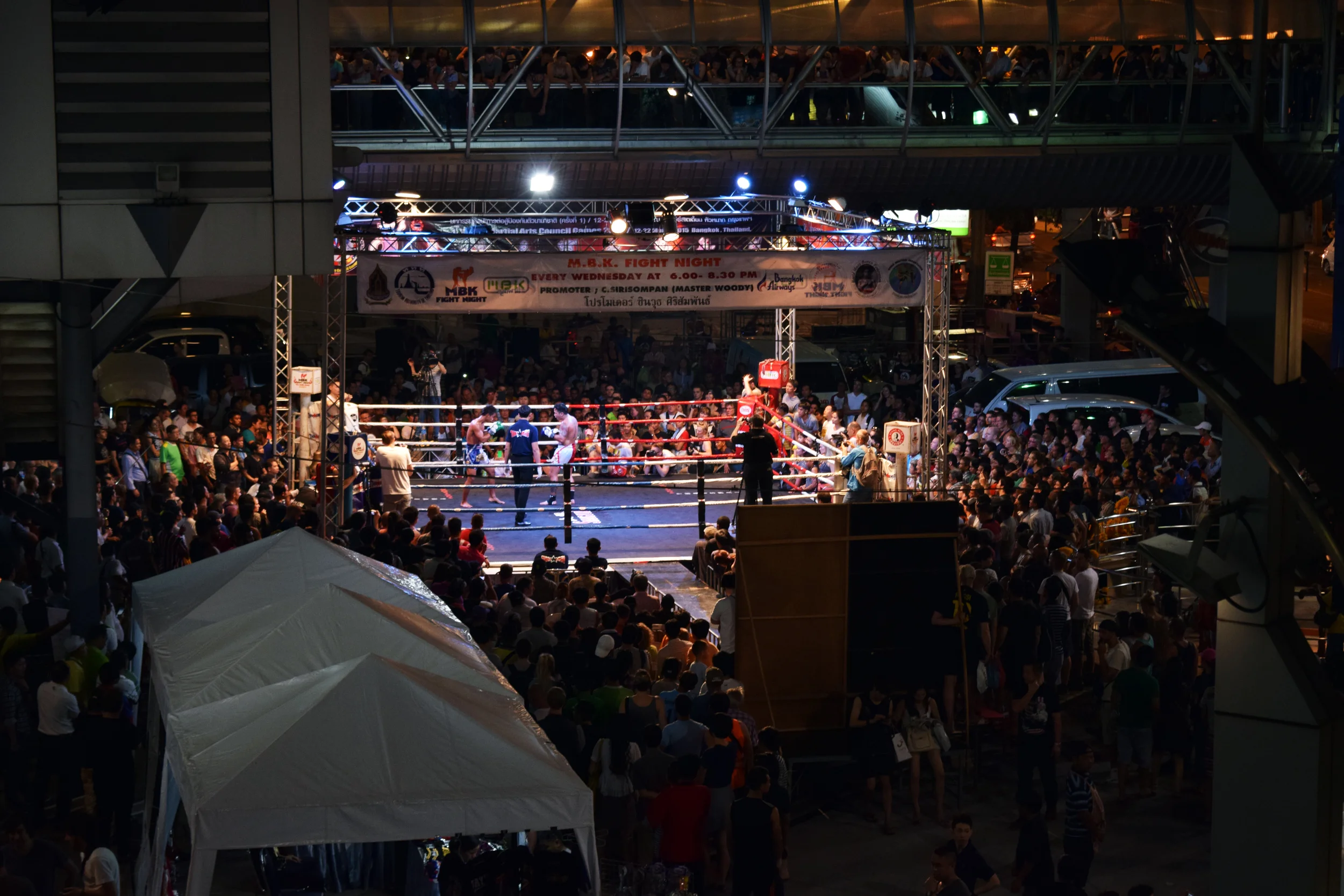
We were climbing the thin, concrete staircase over the main street and up to the nearest train station when I noticed people lined up against the railing, which overlooked the concrete square in front of MBK. I could hear cheering and shouts in the background. When I peeked between shoulders I saw a large boxing ring set up in the middle of a densely packed crowd. Two men in shiny shorts circled each other in the middle of the brightly lit stage. And above them a tacky, orange banner read, “SIANG PURE, PROUD SUPPORTER OF THAI BOXING.”

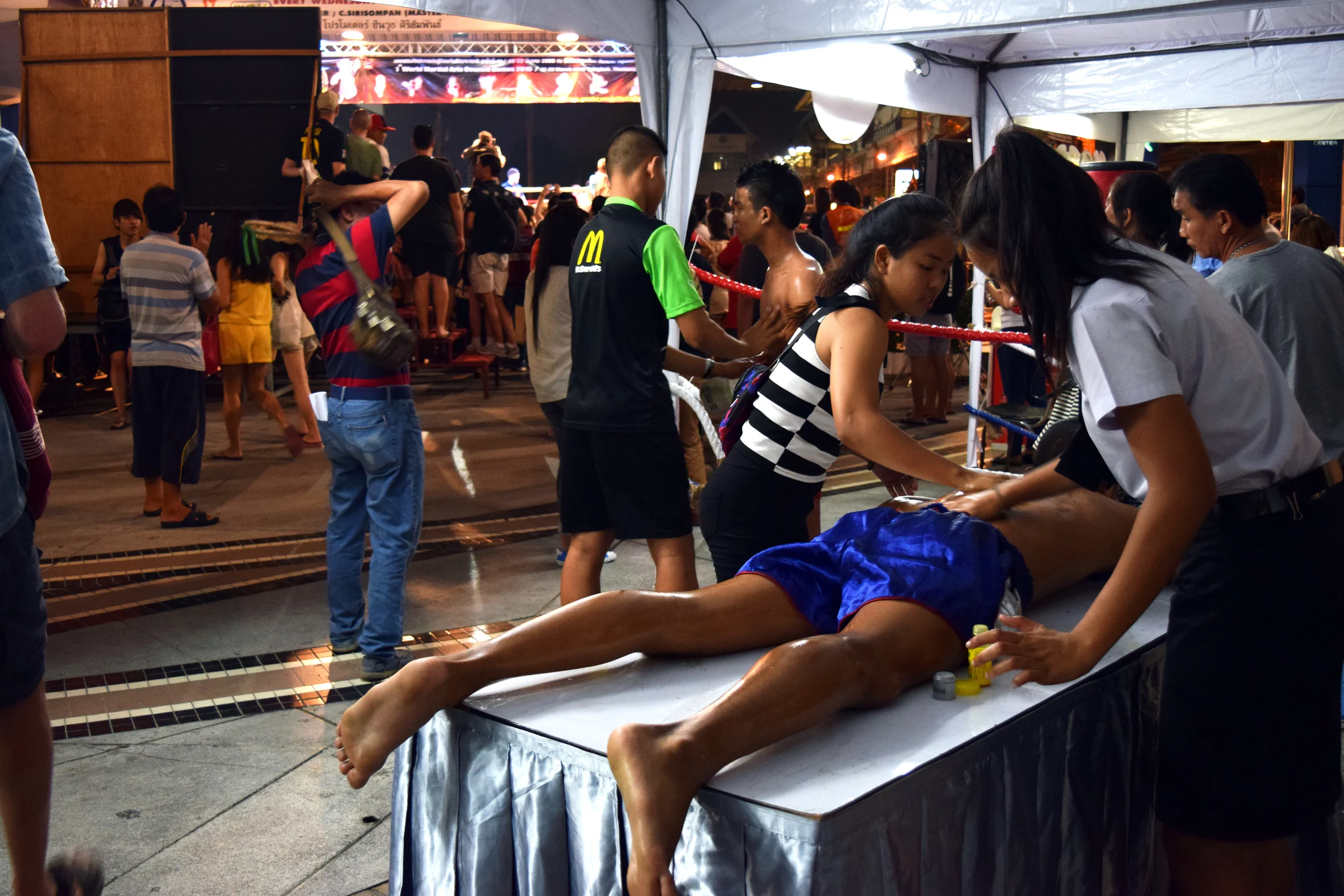
I called my friends back and we rushed down the steps, ran by the endless stream of shoppers drifting from MBK’s sliding doors. We passed a white tent where two women were massaging a young boxer’s back while another fighter in rolled, red shorts had oil rubbed onto his shoulders and arms, bringing out the definition of his lean muscles. He looked young; maybe early twenties at most. 

The crowd around the ring reached the edge of the street and we shoved our way into the masses of hooting, middle-aged Thai men. The fight was already in its fifth round and the two boxers were gleaming with sweat, their eyes dimming from fatigue. It ended just as we got settled, the stockier boxer knocking out his opponent with a heavy right hook that thudded thickly against his left temple. The winner leaned over the thick red cords of the ring, grinning, and raised a glove in the air in triumph. The crowd cheered. Both fighters were escorted out of the ring, and a few minutes passed, but no one in the crowd moved. We waited, hoping there was more to come.

An announcer’s voice came over the speakers, shouting a new welcome in Thai. Models in stilettos, tight black spandex shorts and matching, stuffed bandeau tops sauntered down a runway leading from the white tent we’d passed earlier into the ring. They held up cards with large, black “1’s” printed on them. Two lightweight, bareknuckled boxers marched out after, their hands, wrists, and forearms wrapped in only thick, white tape. One of them was the fighter in red shorts I’d seen earlier in the tent. He moved slowly and his face was expressionless, but you could sense he was nervous; he wouldn’t look at the crowd, just at the ground. His opponent wore navy, and though he was just as wiry and about the same height, his full chest and back tattoos made him appear older and much more dangerous.

The two walked to their corners and a tinny, flute-heavy song punctuated by sharp drums floated from the speakers. It sounded like a proper war tune, one to energize an army before battle. And the men in the ring began to move in rhythm to the music as it began to play, dancing around the edges, raising their legs and arms in turn and bobbing their heads when the synth clanged. They got on their knees and bowed to the crowd, raised their arms above their heads and rolled their legs out. They looked like true warriors stretching before a death match.

The crowd murmured and bustled during the display. People held up one or two fingers and began passing money to several men to my left that stood below a man with a fanny pack standing on a plastic chair (he had a perfect view of the ring). In one hand he held a slip of paper and a pen. Cody lifted me up onto his shoulders so I could get a better view and several men in the crowd asked me to take photos of them, their fingers held up in peace signs (or v’s for victory). 

The music faded and the fighters walked to the center of the ring, faced each other, and when the referee motioned, bowed, touching foreheads. Then they raised their clenched fists up to protect their chests and touched the ground with opposite feet several times. The tattooed fighter kicked out and his opponent leapt back, dodging it. They repeated this, lightly kicking at each other, testing out possible weaknesses.

Then the tattooed fighter looked up, locked eyes with his opponent and swung his body forward, pulling back his left arm for force, and threw a straight punch with his right fist. Red shorts saw it, but swung to block too late, and the first fighter’s fist caught him on the jaw below his right ear. Hard and fast. He was flung backwards, stumbling on one foot before he hit the ring’s ropes. He fell forward on his hands and feet and took half a step as if he meant to get up before collapsing flat on his stomach. He lay still. 

It was so fast that if you’d blinked, you would have missed the whole thing. The tattooed fighter must have known that his opponent wouldn’t get up; he turned away after the hit, adjusted his shorts, and just watched, not bothering to lift his arms to a defensive position. The crowd went wild, shouting and howling in shock and awe as the referee ran over to the downed man, counted to three, and pointed out the winner. It was a one-hit KO, a rare occurrence in any professional fight. 

The man on the ground lay there for a long time, his eyes open in slits, and a doctor checked his pulse before they were finally able to get him to sit up and hobble over to the side of the ring. He looked like a zombie. When the referee raised the winner’s arm in the air and walked him in a circle so the crowd could see, the fighter barely smiled. He stared seriously into the crowd, bowed, and quietly left the ring. 

MBK, Oh How I Hate You

Location: Bangkok, Thailand

I’ve never been a fan of malls; I’ve always preferred a day under the sun to a shopping trip. The never-ending stacks of identical clothes, over-eager salesmen, and bass-heavy, shitty top-40 background music only irritate my indecisive nature and overwhelm me every time. So it’s not surprising that both times I’ve been to MBK, an eight-floor, mammoth shopping center, I didn’t really enjoy it. And I never thought I’d include an entry about a freaking mall in my travel blog, but I don’t think I’d be doing justice to Bangkok if I don’t write something about its extraordinary megamall culture. 

The first thing I noticed as we pulled up to the towering, three-block-long, colorless monument to consumerism that is MBK, was the cluster of food and clothing stands around it. The area wasn’t packed, but people still milled about in this cheaper extension of the mall. It was a stereotypical Southeast Asian marketplace: a string of tightly packed, slightly dirty, pretty cheap, makeshift stalls with a questionable hygiene factor. We wandered by rows of fat, barbecue squid skewers, printed tank tops dangling from thin, rusty metal hangars, towers of white, foam takeaway boxes, and whole, plucked ducks hanging from hooks. Plastic tables lined every millimeter of gritty, gray sidewalk and as we walked by them on the black asphalt, the wheels of passing cars and scooters barely missed our feet.

But once I took my first step into actual mall territory, entering through the fingerprint-less, automatic sliding glass doors, it was like I’d crossed the threshold of another dimension. I’d never seen a shopping center like MBK in any of my travels. There were probably thousands of people in that building — all working, wandering, and shopping. The slap of shoes against the spotless, white, diamond-tiled floors echoed lightly and was muffled by the buzz of hundreds of voices. The fluorescent lights across the ceiling were incredibly bright. They reflected off the shiny walls and floors, so it seemed like light was coming from every direction. When I stood in the middle of the huge ground floor, escalators flanked me on all sides. 

We’d come to MBK for SIM cards for our phones; Bangkok is a massive clusterfuck of roundabouts, six lane highways, and skinny alleyways, and we were sick of being shafted by taxi drivers trying to hike up our meter price on a couple of trips. The mobile mart, a sprawling web of glass stands stocked with secondhand electronics, fakes, and phone accessories, was on the fourth floor. We found an escalator by the food court and rode it up. The trip from the second floor to the third was easy as well, but the next set of escalators was halfway down the mall, crammed between leather shops and an area devoted to furniture. It felt like we were wandering in circles. 

Setting up our phones with SIM cards was tedious, boring, and hellish. Nobody spoke English; our questions were ignored. Every station sold the same product for a different price. I had to ask over and over again until I finally found the cheapest option and was able to haggle it down to a reasonable cost. One vendor would give us a price, shout in Thai with a coworker, and tell us a higher number. SIM cards in Cambodia had cost me about $3 for a month with 1GB of data. I paid nearly $20 for the same product in Bangkok after going back and forth over the numbers for nearly forty-five minutes. And the first set of SIMs didn’t even work; we waited a half hour for the saleswoman to hook it all up, then another half hour to re-do it when the defective SIM wouldn't respond to my phone. As I stood there in the sterile mall air, shaking my head at the bored sales rep in front of me, I felt myself losing faith in humanity. 

When we finally exited through one of the mall’s spotless automatic sliding doors and the muggy air embraced my skin, swallowing me in its warmth, I breathed a sigh of relief.

Fast & Furious 8: Bangkok Gridlock

Location: Bangkok, Thailand

Every time I’m in downtown Bangkok, I think that it would be the perfect setting for another Fast & Furious film (RIP Paul Walker, you ironically fated soul). My sequel would take place throughout city center; the drivers would speed down the stacked expressways that wind between the buildings and above the streets, and do crazy, fiery jumps from one level to another. Cars would flip off shiny glass skyscrapers and blackened, concrete housing projects, through construction sites and over trains. And of course I would title it after the daily, hectic traffic: Fast & Furious 8: Bangkok Gridlock. 

The traffic in Bangkok is pretty heavy most of the time, but the early evening rush hour leaves lanes bumper-to-bumper for hours. And in that kind of traffic, taxi drivers refuse to take on passengers asking for rides outside of downtown for less than 400 Baht, or $12 (which is incredibly expensive in Thailand). It was our second day in the city, and I guess that was pretty obvious, because when we hailed a taxi and offered 200 Baht for a ride to MBK (about $6.60, a pretty standard fare from Lat Phrao to that part of town) the driver refused. He wanted 300 Baht (about $10). We told him he was crazy; earlier, we’d looked up the route on Cody’s laptop. It should have only been a 35-minute ride, maybe 250 Baht at most if we ended up in traffic. The cabbie told us he’d prove that the route was worth 300 Baht; we could take the ride metered. We agreed, stupidly.

Sidenote: most of the time taxis here don’t use the meter. They usually just haggle a price with their customer. I’m not sure if that’s because it’s easier and they already know how much it costs or what.

We hadn’t picked up our SIM cards yet and didn’t have Google Maps to guide us. So none of us knew where the hell we were in Bangkok. Twenty minutes into the air condition-less, sweaty, shoulder-to-shoulder ride, Baby saw a sign for our neighborhood, Lat Phrao. We thought that was a little strange, but weren’t sure what to think of it. The meter still said we only owed 55 Baht. Our driver drove us over several expressways (where he demanded we pay the tolls, each about 40 Baht). Forty-five minutes in, Liam and I noticed we’d passed the same skyscraper going two different directions. We had now reached 200 Baht. And the truth was beginning to dawn on us. Still, without Internet in this huge city, we didn’t want to piss off our already pissy driver any further and have him dump us off on the expressway. He couldn’t speak much English, but I was sure he was able to discern our murderous tones as we grumbled to each other. Finally, after an hour and a half, once the meter had hit 317 Baht, he dropped us off in front of MBK. He grinned as we handed him the money and crawled out of the cab, whining about how our asses ached and our legs had fallen asleep.

That motherfucker swindled us, and swindled us hard. Later that night, we haggled a deal with another driver to take us back home from MBK for only 150 Baht. And his anger at our excellent deal was demonstrated by his intense need for speed. (There are no seatbelts in the backs of these taxis, by the way.) We nearly hit several cars on our way back to Lat Phrao and made it home in less than 20 minutes.

Feast Your Eyes: An Ode to Street Food

Location: Bangkok, Thailand

The street food scene in Bangkok is out of control and somebody has to take advantage of it. And that somebody is me - I’m going to eat my way through this city. I’ll be feasting on Pad Thai for $1, trios of mangoes for $0.75, bubble tea for $0.75, hot and sour pork soup for $1.25, BBQ chicken legs with rice and spicy sauce for $1.50, dumplings for $0.75, and so much more. Some people get nervous about street meat and question how long it’s been sitting out in the muggy heat. They use words like bacteria, diseases, hygiene, blah, blah, blah. I like to think of the next couple weeks as an experiment in strengthening my immune system.

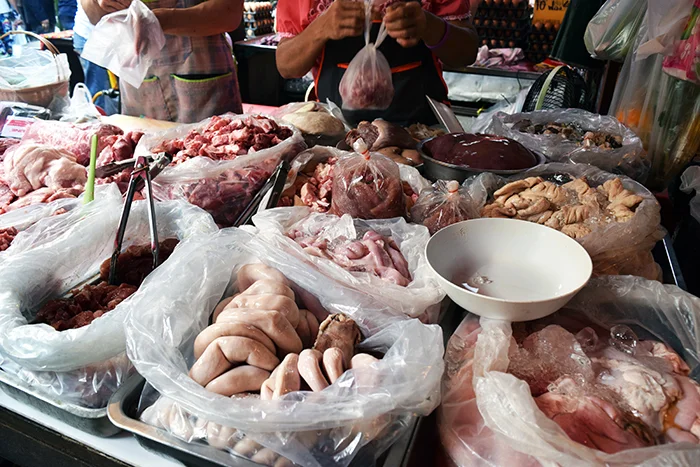
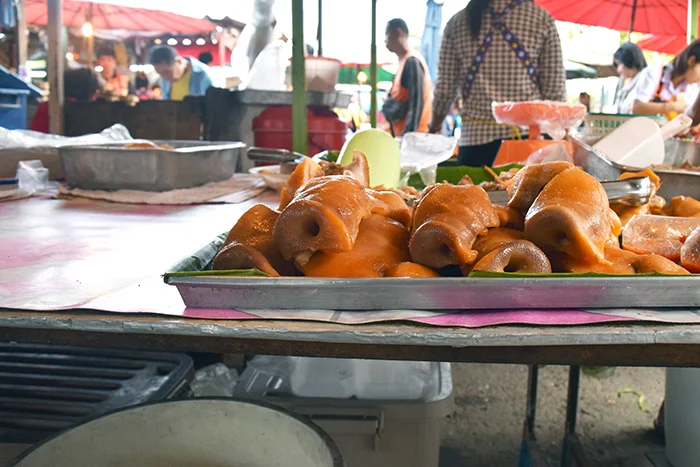
I’m staying down the street from a traditional, open air Thai marketplace. It’s a little maze of stalls that provide everything from fully cooked meals to raw veggies and meat to bubble tea. Basically everything I need to eat myself into a food coma on a daily basis. The salespeople are open to haggling and the prices seem pretty fair. I don’t think many foreigners come through this part of town and I get quite a few stares whenever I wander through, but it’s not enough to keep me away from all the flavorful deals. The photos I’ve included in this post are all shots from that market. 

One of the tastiest new treats I’ve stumbled upon (sometimes hunger drives you to try things you’d never give a second glance) is a crispy, paper thin pancake shaped into a mini-taco. It’s stuffed with a sweet coconut cream very similar to a fluffy meringue and its sprinkled with sweetened, preserved egg yolk. Holy shitballs was that delightful. I search for them every time I’m out and about, now. It costs about $0.25-50 cents for a bagful. 

Seriously, though, every meal I’ve had so far in Thailand has been scrumptious and dirt cheap. If you’re an adventurous food lover, this place is built for you. 

Expenses

  • Bubble Tea: $0.90
  • A Full Meal: $1-1.50
  • Dessert: $0.50-1.00

Travel Tips 

  • If Thai locals are staring at you, don’t feel particularly uncomfortable about it (unless you’re actually doing something wrong). It’s not considered impolite in the culture. And if you leave the main tourist areas of Bangkok (Khao San, Chinatown, etc) you will get stares. Just smile, wave, and enjoy your celebrity. 
  • Never accept the first price someone gives you, especially in a marketplace (unless it’s written down). At least attempt to haggle. The first time I tried to buy mushrooms in the market, the woman asked me for $1.75 a packet. I stood my ground, laughed at her price, and was able to get two sets for $1. 
  • Don’t be afraid to order food at a restaurant or stall without an English menu. Locals assume you’re a dumb tourist that doesn’t speak the language and are often happy to help. Many menus have pictures you can point to, as well. A little bit of patience gets you a long way in this country.