The Motorbike Chronicles, Part VI: Stay Tuned for Scenes from the Upcoming Episode

Location: Vientiane, Laos

Tuesday finally came. The hospital sent word to the Australian embassy that the biker was stable, conscious, and even up for a visit at Vientiane’s military hospital. Jack scheduled an appointment with Jody to visit him the next afternoon. Jody and the embassy’s translator, Phvong, would accompany Jack to help with negotiations.

I couldn’t help but wonder what they were negotiating. The price of a man’s life? Laos’s tourist tax? What was this awful accident worth to the biker, to the Australian Embassy, to Jack? Being the curious creature that I am, I asked if I could come along and hopefully observe some of the madness. What sort of bureaucracy and corruption would we encounter at the embassy? At the hospital? 

I also needed to witness the biker walking and talking to rid myself of the nightmarish visions that were haunting me, the vivid flashes of him lying limp in the road. 

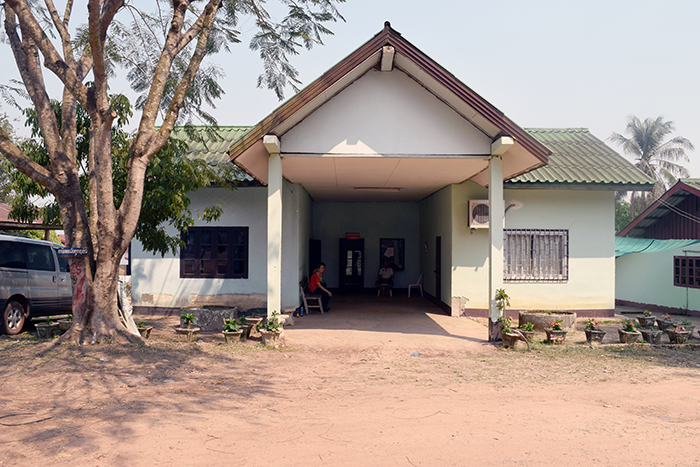
The embassy was well guarded. Steel fences with spikes held up by white concrete pillars. A guardhouse at the entrance with metal detectors, plastic signs describing what you could and could not carry into the building, and two security guards in fresh-pressed uniforms. I hadn’t brought my passport (my own personal safety measure), and they wouldn’t let Jack or me into the building without identification until Jody finally rang and confirmed the appointment. I dropped my camera and cell phone into a metal bin that slid out under the glass screen that separated myself from the guards. My electronics were replaced with a plastic name tag on a lanyard.

I walked through the metal detectors, out the guardhouse door, and stepped into a place in such stark contrast to Vientiane’s dusty streets that I had the ridiculous thought that I’d maybe wandered into a Dr. Seuss picture book illustration. 

I was surrounded by a luscious garden which led up to a huge, teeth-brightening-ad-white building. The grass was laughably green, and upon seeing the number of sprinkler heads peeking up between the neon-y blades, I dissolved into giggles of disbelief. Everything glittered that starry, dewy glitter of fresh water droplets. It was the greenest place I’d seen in Laos so far. Vientiane itself was brown from the cracked sidewalks to the muddy riverside to the crumbling buildings. But here, tropical plants, including curved palm trees and red and purple birds-of-paradise flowers, lined the path, which was a mix of manufactured, decorative pebbles sealed together by concrete. 

And when we entered the embassy building/palace, it wasn’t just clean, it was immaculate. I felt bad when I pushed open the glass doorway with my fingers; someone would probably have to wipe that down immediately. The lobby was decorated in spotless, new, contemporary-to-modern style furniture. There was glass everywhere, from the large windows overlooking the too-green yards to the balcony overhanging the first floor. I could see through it to the square, leather lounges up above us.

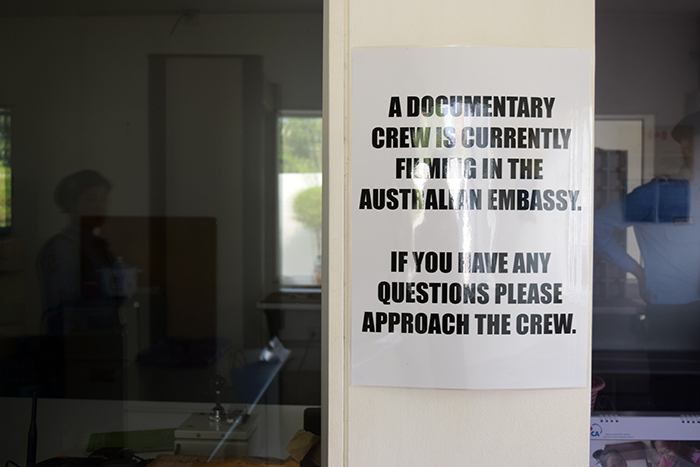
We met Jody and the film crew in a windowless side room with a wooden table surrounded by swiveling office chairs. The crew recorded Jody going over the next steps with Jack. We found out the biker’s name was Meksavanh Pathoummakong and that he had been recommended by doctors to remain hospitalized for at least the next day or so. When Jack saw Mr. Pathoummakong he should voice his concern for the man, his family, and the accident. He should keep calm at all times. Though Jody couldn’t take part in anything dealing with money (Australian law), Phvong would act as a go-between for Jack and the biker. Everything should be fine as long as everyone played their parts. 

But could Jody really know what was going to happen when we met the biker? I couldn’t tell if her aura of calm was for the cameras only. 

I wondered what angle The Embassy was looking for. Did the editors want the audience to vie for Jack’s innocence? Young Australian involved in brutal accident falls victim to police corruption and blood money scam. Or were they looking for a villain? Careless Australian pedestrian vacationing in Laos involved in motorbike accident walks away, local man hospitalized with serious injuries.

The film crew took multiple shots of me nodding as Jody spoke and I wondered what part I played. Would I get a title in the script? 

Cassia, 23. Jack’s Friend and Fellow Backpacker. 

Or maybe it’d just be a mention, my bobbing head a most minor character in the script. 

Friend of Jack.

Maybe I’d just be cut entirely. I preferred that, actually. I had come on this visit as an observer, as a support system for my friend. It was strange thinking for once I’d be at the mercy of editors instead of editing someone’s story. 

It was also difficult for me to reconcile the experiences of our past few days with what was in front of me: Jody’s clean, red, polyester uniform, the disposable, plastic cups of water they kept offering us as we sat there during the briefing (we were informed it was fancy filtered tap water, not from a bottle at the supermarket - the first drinkable tap water we’d encountered in Southeast Asia), and the classic, office-building fluorescent lights that turned us all that sickly shade of not-quite-natural-lighting-yellow. How could this place exist only a few hours from the village where we’d been left so helpless on the side of the road, trying frantically to revive an unconscious man and waiting forty-five minutes before a police officer arrived and flagged down a random military truck to take him to a hospital?

Well, if I’d learned anything from the past few days, it was that life can be as strange as it is brief. 

When the camera had been turned off and Jody and the crew had left the room, I noticed Jack’s face had paled. He was looking down at his untouched cup of complimentary water. 

“Are you okay?” I asked. 

“Yeah, yeah. I just want to see that he’s okay.” 

“He is! The hospital said he is.” I put on a cheery tone, placed a comforting hand on his shoulder, and hoped that I sounded more confident than I was. 

“I’m really nervous about all this.”

“It makes sense that you’re nervous. Everything’s going to be okay, though. Jody and Phvong totally know what they’re doing.” More fake confidence. 

“Yeah.” He looked like he might be sick. 

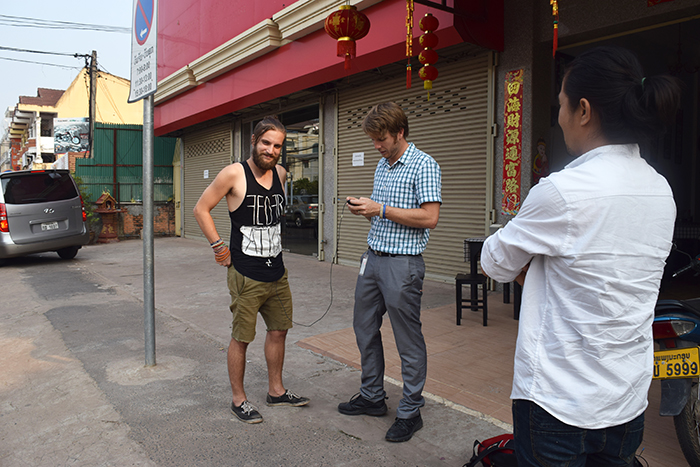
Jody, Phvong, two embassy drivers, the producer, the camera man, Jack, and I all hopped into an unmarked van and headed to the hospital. When we sat down, the camera man informed us we had to wear seat belts. Otherwise, they weren’t legally allowed to film us. I fumbled with mine; it was the first time I’d worn a seatbelt in months. Jack and I exchanged an amused look over the idea of vehicular safety on these Laotian roads. Jody sweat through her uniform dress and grumbled that the film crew insisted she wear it, even though she usually never did outside the air conditioned office. We laughed at how preposterously formal it made her look. As we rode through the city, the crew asked everyone to act serious and took shots of us staring silently out the car windows. 

The hospital was a large complex of multi-story buildings surrounded by men in green and beige military uniforms. No cameras allowed there, either. When we wandered into the first door we came across, a doctor pointed us back a few hundred meters to one of the last buildings on the edge of the square. Mrs. Pathoummakong met us at that entrance. She wore a shiny, embroidered chartreuse skirt and matching blouse and her hair hung in a long, thick ponytail down her back. She smiled and waved as we approached. It was a distinct change from the last time I’d seen her, half-sobbing into tissues at the police station, pointing at us and crying out “farang, farang.” I felt good about it, though. Maybe it meant her husband really was okay. 

She led us through the building, which was small, a maze of narrow hallways littered with shoes. Several pairs were identical to the ones the biker wore on the day of the crash. All black, nondescript, cheap. Rubber bottoms, short laces like loafers. A bit scuffed on the edges and creased around the topside from constant wear. I couldn’t look at them too long without remembering how one of them had slipped off that day and tumbled down the road, Mr. Pathoummakong’s foot left only in a navy sock. 

Everything seemed old, but maybe that was because I’d just come from the Australian embassy. All the rooms had windows facing the hallways and I could see through the smudged glass and the open doorways that each one was filled, corner-to-corner, with stretchers and bodies. People even lounged in the corners of the floor. Several fanned themselves with woven bamboo. There were no hospital gowns; everyone was just wearing their day-to-day clothes. I couldn’t tell the difference between patients and visitors. There also weren’t any doctors or recognizable medical equipment around. It seemed more like a holding area than an actual hospital, and maybe that’s what it was. 

We slipped through a crowded room of metal stretchers and bored-looking patients and I almost tripped over the foot of a scrawny, elderly man crouched beside the door. His jeans and t-shirt were gritty and his toenails were brown and chipped. I nodded my apology and he grinned back at me, totally toothless. We entered a back room where the biker lay. His wife claimed a spot behind his stretcher and faced everyone. 

Mr. Pathoummakong’s lip was stitched up, but otherwise I couldn’t see any external injuries. He waved when we entered the room and asked which one of us he’d hit. When Phvong pointed to Jack, he shook hands with him, still laying flat on the bed. He wore shorts and a red-and-white striped polo.

It was a strange scene: all six of us lined up in a semi-circle around the bed. There was only one other occupant of the room, an unidentified woman in a traditional green dress who sat crosslegged in her stretcher. I leaned back against the metal bar of her bed while Mr. Pathoummakong, Phvong, and Jack spoke. She and I watched everything play out. 

Phvong translated as the biker described his injuries, still laying flat, his eyes peering down his nose at us, and gesturing with his hands. 

“He says the doctors say he may have injured his brain from how fast he hit the ground. Like his brain moved when he hit. He had an MRI and they said it’s all okay, but he still can’t sit or stand up without experiencing dizziness.”

We all nodded.

“He says they don’t know how long he has to stay in the hospital, maybe a long time. They have to see how he recovers.”

Mr. Pathoummakong showed us his lip, which was swollen and sewn back onto his face. It had eleven stitches keeping it in place. The messy black x’s of string looked painful, crude.

Jack asked Phvong to translate, “I hope you’re well and I understand the stress that you and your family are going through.”

“He says it means a lot that you came here to the hospital see him.”

Jack stood with his hands twisted together in front of him. All of the pleasantries were making me nervous; everyone was waiting for the same moment. Why not get it over with? I noticed the camera man for The Embassy was secretly shooting footage on his iPhone. I was torn. I wanted to smack it out of his hand; he hadn’t asked anyone for that coverage. But the journalist in me appreciated the undercover effort. 

Footage inside a Laotian military hospital? Nice. 

“How do I ask how I can help?” Jack asked Phvong.

“He says you can help with the medical bills since he hasn’t been able to work. There are many costs at the hospital. He had to pay for transportation to the first hospital, and then for when he was transferred to this hospital. He also says the MRI cost 900,000 Kip…but yesterday he told me that it only cost 800,000. I am not sure what the actual price is, now.”

Mr. Pathoummakong continued rattling off expenses and Phvong’s cheer took a downward spin, and a frown etched across his features. 

“He says that they don’t know how long he has to stay in the hospital and he wants to know how long you are in Laos, if you want to give him money now to pay for some expenses, then more depending on how long he has to stay.”

Jody peeked her head through the door. 

“Don’t answer how long you’ll be in Laos!”

“He also says that he wasn’t drinking when the accident happened and because he works for the military, he doesn’t have to carry a license to drive a motorbike. His military status also means the police will side with him in any investigation.” 

I caught the producer’s eye.

Is that a threat? 

He wanted $1000. My jaw dropped. Cody and I had both been cleaned up at the hospital after our accident and been given loads of medicine for a grand total of only $16. Obviously this was different, but I couldn’t shake the feeling that well, Jack was being shaken down. Jack responded that he didn’t have much money, he was just a young traveler. He offered $400. Mr. Pathoummakong angrily gestured that that wasn’t enough to help with the damage. The room grew tense as the negotiations moved forward. Finally, he and his wife summed up the total costs for medical bills to be around $700. 

There wasn’t really any arguing. If Jack didn’t comply, they wouldn’t sign the papers allowing him to get his passport back. And then he would pay thousands of dollars in court fees and visa extensions for a verdict that would most likely deem him guilty. 

“I don’t have that much money, but I’ll try to see if I can get it. Will you tell them I need to figure it out?” Jack said. Phvong translated. The Pathoummakongs stared at him unhappily. As we filed back out of the room, I shook hands with the couple and bowed awkwardly. 

I left the hospital feeling less relieved than I’d expected. I had that tight ball in my gut, the one that I always got when I felt like someone was taking advantage of someone else. Like all the concern I’d felt over the past few days had been taken for granted. Like Jack had been duped. We were the only ones that attempted to help the man when he was knocked out on the road and now here he was, extorting one of us for as much money as he could get. 

Jody apologized as we left the hospital, informing Jack that she’d usually debrief him on “next steps” immediately, but The Embassy had asked her to wait until they’d reached a location where they could film it. You know, get a genuine reaction. 

On the way to the provided location, the producer asked Jack if he could do a short interview during the drive, tell them how he felt about everything, act as if they were headed to the hospital instead of leaving it. Then they filmed us all staring contemplatively out the windows again. This time, nobody had to fake the pensive looks.

The debriefing happened at a fancy coffee shop in Vientiane that served real lattes, not just gritty drip poured over a base layer of condensed milk. They came out in fancy, clear glass cups that kept the coffee in a central tube so it’d never be too hot to hold. The filmed meeting was short and sweet. Jody and Phvong explained that everything had gone quite well and Jack said he was just glad the guy was okay, that he’d have to work out the money. 

When the cameras were turned off, Jody remarked that it was unfortunate the family seemed less genuine now. That they’d changed prices of everything several times. That they were hoping they could squeeze as much money out of Jack as possible. I could see from the look on her face that she felt that same tightness in her gut as I did.

Later that night, Phvong called Jack, apologizing profusely as he told him he’d forgotten about the “police investigation fee.” Jack would also need to get out at least $200-300 to pay for those six hours we were detained outside of Nakam. The six hours of waiting while the officers sat around, ate, smoked cigarettes, and took turns hitting on me. The insult was incredible. It was like eating at an overpriced restaurant, enduring poor service from a bored, rude waiter, and then being handed a bill with gratuity already included. 
The Motorbike Chronicles, Part V: Farang, Farang

Location: Vientiane, Laos

This whole situation is too surreal for me to properly process. People keep telling me I’m in shock when I calmly explain that in the past week I’ve been in a motorcycle crash, almost watched a man die, been detained, and that my friend’s passport is being held by the Laotian police until the Australian embassy can figure out how to get it back - which may involve paying a large sum of blood money.

But here I am, elbows propped up on a pillow, typing this out on a hotel bed in Vientiane where we’re staying until things get sorted. That corny, feel-good Julia Roberts movie, Stepmom, is playing on HBO, the only English channel we have, for the second time in three days. As the ticker across the top of the screen flashes that Notting Hill is coming up next, I hear Baby groan from his spot on the bed beside me.

“Not again…” Baby says. This is the third time Notting Hill has come on this week.

“I’m impressed by the size of HBO’s Julia Roberts boner.” I say.

“Whoever is in charge of HBO’s movie choices here needs to get fired.” Cody says. 

It’s just another day in Vientiane, waiting.

We’ve spent more than our fair share of time in this hotel room. It’s been three days since Cody, Jack, and I were released from the police station and bused back to Vientiane. But it wasn’t until today that Jack even had a meeting a representative with the Australian Embassy. The ambassador, Jody, basically told him they couldn’t help until the weekend and public holiday (International Women’s Day) had passed. Everything in Laos was currently closed. Jody had actually come to visit Jack on her day off. We weren’t even sure if Jack’s passport was in the Nakam police station or one in Vientiane.

Everything we know about the case revolves around government bureaucracy and corruption. We’ve learned the tourist’s lesson of cultural divide the hard way: even if one of the locals runs you down with his moped and gets injured because his helmet isn't on securely, it’s your fault. The reigning mindset is that if you weren’t in the country, the accident never would have happened. Police don’t want to handle investigations, but if it comes to that, the process could take months and you’d probably be found guilty anyway because of your status as a foreigner. 

No one has mentioned the exact figures for compensation, but it’s not looking like there’s a way around paying it, whatever it is. Jack’s also been in touch with his travel insurance, but they’re refusing to pay out because, as they stated several times to him via email and over the phone they "don’t support government corruption.” If Jack was injured or if he was actually at fault, they’d cover him, but since he was a pedestrian and technically the biker should be at fault, they aren’t liable. It’s all just a big, mind-fucking loophole. 

Every few hours or so I find myself unzipping my backpack and slipping my hand into the fitted pocket where I've tucked away my own passport. Just running my fingertips over the plastic-cloth cover, holding the weight of that little blue book in my hand, comforts me. Watching Jack sweat over the fate of his own international identification document these past few days constantly reminds me how lucky I am, that it could have been me that stepped out into the road. 

And luck has been with me recently. Yesterday, after a flurried, breathless search and the help of several kind Laotian strangers in the maze of Vientiane’s morning marketplace, I was able to meet up with the Laotian woman who we’d hitchhiked with to Nakam and in whose pick up truck I’d left my Samsung Galaxy III. When we found each other in the market and locked eyes, I threw myself at her in an utterly un-kosher hug, which she embraced with open arms. She refused to take any payment for keeping my phone safe and bringing it back to me. That little lady will forever remain my Guardian Angel. 

From the corner of my eye I can see Baby flicking through messages on my phone, its shiny ruby-red plastic cover glinting in the afternoon light. He’s checking the ad we put up for his motorbike, which he rode back from Vientiane the day we spent at the police station. The bike actually broke down on his way back, leaving him stranded in another teeny village. It took him hours to find a mechanic that could understand him and he ended up spending almost $50 replacing the entire engine before it was road-worthy again.

Fortunately, the ex-pat blog we posted the ad on has had a steady stream of hits. He’s hoping to sell the bike to a Portuguese guy later today for $150. I actually wrote the ad the night we stayed in Nakam and, for obvious reasons, felt obliged to leave out our recent accident and short-term ownership of the bike itself, so I fibbed that Baby was on the way to Thailand and just didn’t need it anymore. Now, the potential buyer wanted to pay half in Baht, the Thai currency. 

Baby shoots me another dirty look as he replies to message. “What am I supposed to do with Baht?” He grumbles. I chuckle to myself. 

Cody is lying on his back on the other side of me; he hasn’t been able to do much more than shuffle down to the nearest street food joint over the past few days. He carefully clicks away at his Chromebook’s keyboard, the first draft of his novel filling out across the digital page. The wounds on his knees, forearms, and palms have kept him mostly bedridden. His blanket is stained with a nauseating mixture of iodine and pus. But both he and I have been cleaning and sterilizing our scrapes on a daily basis and so far neither of us seem to be suffering from infection.

When I peer out the window, I can see Jack, Jody, and the Australian film crew for the show, The Embassy, at the French cafe across the road. Jack signed away the rights to his story this afternoon, and the events of the past few days will soon be edited into a segment of the “banged-up abroad” style series. It’s strange knowing you’ve taken part in an event so out of the ordinary that people think it’ll make good TV. But Jack’s fifteen minutes of fame have helped distract all of us from the seriousness and monotony of the past few days and I’m glad for the excuse to laugh as the film crew does what seems like the seventh take of him and Jody shaking hands, re-enacting their first ever meeting, again. 

Jack wanders back into the room as Julia Roberts’s character's hormone-addled, adolescent stepdaughter confronts her with one of the most overused lines in films and shows about step-family relationships. 

“I don’t have to listen to you, you’re not my mother!”

Julia, in her oversized, colorful 80’s garb, her posture, hair, and manicure perfect (as a young stepmother’s always is), doesn’t miss a beat with her own selfish, stereotypical line. 

“Thank God for that!”

Jack shuts the door and I peel my eyes away from overplayed scene. “Is it okay if The Embassy films us all playing cards or something, tonight? They said they’ll buy us a round of beers if we do.” 

We all kind of nod, half-interested. There’s nothing on television, anyway.

The Motorbike Chronicles, Part IV: Detainment, I Guess

Location: Phonhong District, Laos

When we arrived at the police station, a one-story complex surrounded by thick, low concrete fences, Jack, Cody, and I were filed out of the van and pointed to a rickety wooden bench half-shaded by the roof of a dirty stucco building. We dropped our backpacks into a pile. Jack and I sat on the bench and when we did, it wobbled so much Cody refused to join us for fear of it breaking. One of the police brought out a red plastic stool for him to sit on. 

We were quiet, calm. I think we were mostly just too shellshocked and confused to freak out. The crash kept replaying in my head; the biker flying limply through the air and flopping to the ground. His face too flat against the pavement and his limbs splayed out like a child’s discarded doll. The blood spilling through his teeth, his bottom lip flopping to one side.

Is he okay? God, I hope he’s okay.

The cops were friendly and casual, which caused the whole situation to seem surreally routine. I figured we were just dealing with the slow police system in Laos; they probably had to double check some paperwork and then we could go. Copy our passports or something. It was hard communicating between parties; the language barrier had us speaking through wild hand gestures, shaking our heads when we didn’t understand and smiling apologetically. But even the fact that we were being held by the police wasn’t too intimidating. The station itself was really just a row of small buildings with awnings crafted from tarps and sticks.

There was a wooden garage where they kept vehicles, including a green military truck and several motorbikes, as well as a picnic table surrounded by an assortment of stools. The only toilet was behind the buildings and down a set of stone steps, past a rectangular, concrete platform similar to a basketball court and in the middle of a grass patch. It was surrounded by chickens and ducks and the ground around it was a mess of muddy feathers, grain feed, and bird shit. The bathroom itself was a two room, windowless wooden outhouse and each dark, dank stall was fitted with a plastic squatting toilet cover on a wood platform, a leaky tap, a plastic bucket filled with water, and a smaller bucket for scooping it out. There were no lights and when I first went to use it, I found the latch had broken off the door. Behind the toilet was a thin, broken bamboo fence that separated the complex from a swampy pond and the green fields beyond. 

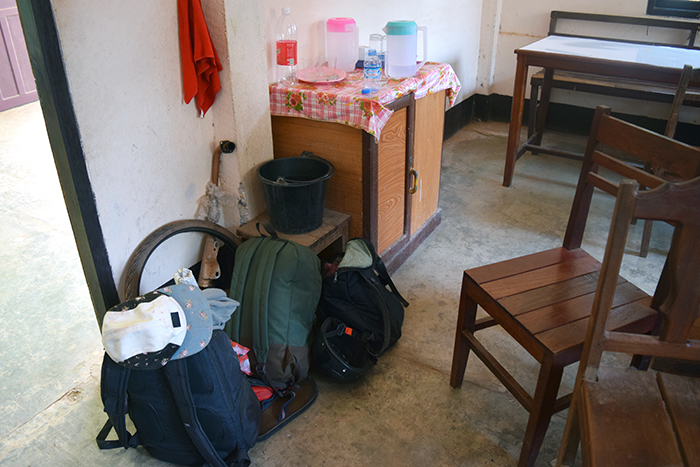
We waited for about forty-five minutes before one of the cops came out and called Jack inside the office. A few minutes later, another cop, a slender, smiling man with thinning hair, waved Cody and myself into the room and sat us on wooden chairs facing Jack across a table. We piled our backpacks into the corner. The head police officer, and the only one who seemed to totally lack a sense of humor, clutched Cody’s, Jack’s, and my passport in one hand. He was copying down our information into another ledger. He grimaced at the papers in front of him.

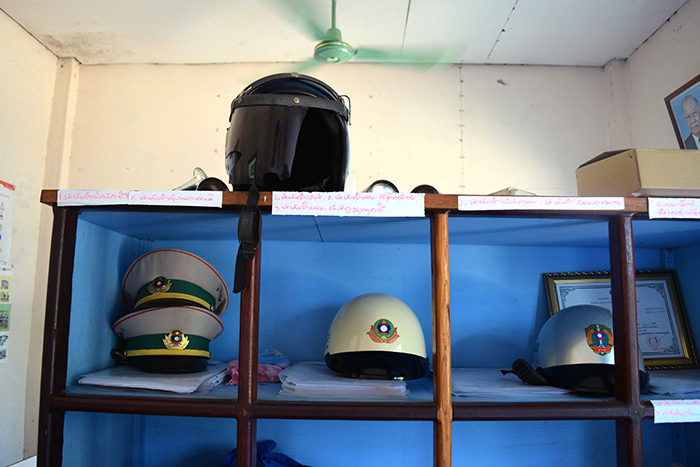
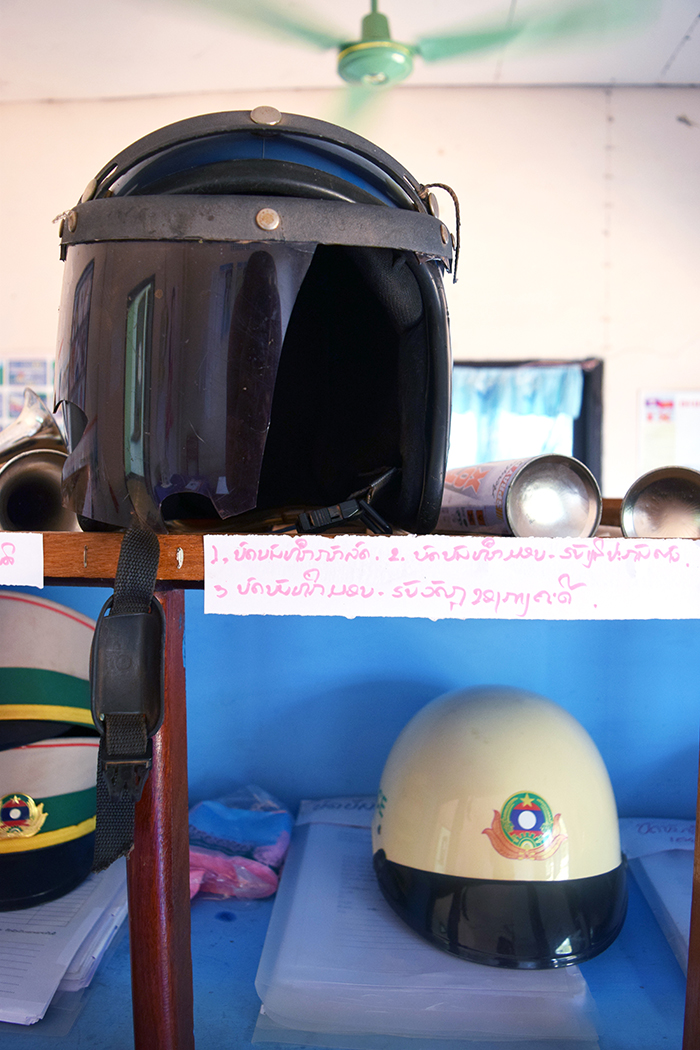
My eyes wandered around the green tile room. It held several desks, a set of shaky shelves where the cops kept helmets and personal belongings, and a couple unplugged electric floor fans. There was a kettle and several cups for water placed on a plastic, red-and-white checkered table cloth in one corner. The shutters (there was no glass on the windows) and door were open and the room was decorated with several large calendars with images of heavily made-up, smiling Laotian women wearing shiny, colorful dresses, their posed figures double the size of the date boards they complemented. 

One of the officers had placed the biker’s broken helmet, the visor cut in half, on the top of the shelves, directly facing Jack.

Once we were all inside, settled into our respective “witness” and “perpetrator” positions, the cops took turns attempting to breach the communication barrier and the one that spoke limited English ended up translating their questions, which were both completely unrelated to the case and painfully uninteresting, in broken half-phrases. 

How old? You like Laos? Where travel next? Where been so far? How meet?

One officer in particular, the smiley, wiry one that had brought Cody and I into the room and offered us chairs, took a liking to me. He asked if I was married, showed me photos of his family, and had Cody take several photos of us together on his phone. I felt awkward as he swiped through the images, pointing out his favorite, the one where we were both smiling most widely at the camera, his arm wrapped tightly around my shoulder. Afterwards, he kept offering me cigarettes.

More time passed. Cody’s scrapes were leaking pus through their thin gauze covers and it was attracting tiny, buzzing black flies. I could tell it was beginning to worry him. I was concerned about the sterilization of my wounds as well. That morning I’d had to rewrap my arm with the same beige band as the night before, even though my gash had bled through. We didn’t have any supplies to replace it. My forearm was swollen and sore, and I tried not to think too much about the dull brown stain on the bandage. One officer handed Cody some toilet paper to lay over his knees and protect him from the onslaught of bugs. It stuck to the shiny liquid oozing out of him.

A cop announced that Jack needed to visit the hospital to have his injuries checked out. He was escorted to one of the motorbikes in the garage. He wasn’t given a helmet for the ride. When he returned, he had a crinkly plastic baggie filled with similar supplies as the one Cody and I were given the day before: Amoxicillin, Panadol, and an orange tube of anti-inflammatory cream. He was still wearing the bandaid I’d placed on the cut on his shoulder earlier. He said the doctor had been concerned about the bruising on his stomach, hip, and thigh. She’d given him some unknown shot in one butt cheek. He’d also seen the biker in the hospital; the man was awake, sitting up and talking to a friend. His lip had been stitched up. He and Jack had met and the friend had taken a photo of the two together.

The biker was conscious and stable.

I didn’t watch a man die, today.

A wave of relief crashed over me and I let it wash through me, relaxing my body, gently releasing the tension I’d held all morning and afternoon.

Some of the cops began making eating motions toward us, spooning invisible soup and handfuls of rice into their mouths. But we all shook our heads; even though I hadn’t eaten since the previous morning, my stomach was too traumatized to feel hunger. After a few more attempts to ask if we wanted food, one cop locked our passports in a drawer of one of the desks and they all left. I stared at the desk in disbelief. 

What the fuck are we doing here? 

I couldn’t understand it. It had been several hours and none of the officers had done anything productive in terms of our case. We’d already given them our witness statements at the scene. Jack was just a pedestrian that had been hit by a motorbike. It didn’t make any sense for them to hold our passports hostage like this. Cody and I weren’t even involved in the accident! Had we transformed from innocent bystanders to criminals when we ran out into the road to help the biker? When we offered information about the accident to the police? It was beginning to sink in that something was really, really wrong and that we might be in trouble.

But still the strange calm held down any visible panic. While we waited for the cops to come back, Cody read a New Yorker article on his phone and I taught Jack how to play Solitaire. 

“Man, it’s already so late in the day. Do you think we can get to Vientiane in time for you to get in touch with that lady about your phone?” Jack asked me while I shuffled the deck. I was surprised that he was even thinking about my phone; in all the mess I’d completely forgotten it. 

“No, and it doesn’t really matter. There’s kind of more going on that my totally replaceable smartphone.” I grinned as I said it. Jack was a salesman for Optus, the Verizon of Australia. I knew that if anyone would care about losing a phone it would be his tech-loving self. 

“I’m sorry though.” He said. I glanced up from the cards and saw Jack looked genuinely sorry. I let out a small chuckle of unconcern. The phone just didn’t seem important in the moment and I couldn’t tell if he was just trying to forget the current situation by concentrating on something else for a little while.

“Seriously, it’s okay.” 

The police were gone for over an hour. When they returned from their trip, joking and chatting away, they sat down around the picnic table in the garage and spread out a feast of noodles, fried pork belly, broth, and greens. I was taken aback by their nonchalance. 

Are we actually just sitting here, wasting our time, because they’re having the longest lunch break possible?

I was fed up with it and wandered outside to question the young cop, find out what information could be translated through his seven months of English-speaking training. I pulled up a stool next to where he sat, his soup bowl empty except for soggy green dregs.

“Why are we here? How long do we have to stay here?”

“Ah, you and Cody can go at the end of day. But Mister Jack has to stay. He sleeps at the police station. I have to do my work.” 

“But why?”

“I have to do more work. He can leave maybe tomorrow.”

Maybe tomorrow. Fuck.

“Cody and I aren’t leaving without Jack.”

He frowned. 

“There is hotels in Vientiane. You go there.”

“No, we’re not leaving our friend.” 

“Then you all sleep at police station.” He nodded, as if that was a sufficient response.

I nodded back and smiled, thanking him for the information and trying to appear unfazed by this news. When I returned to the guys and relayed everything I’d been told, the sheen of calm shattered. Jack, who had been lining up cards for another round of Solitaire, froze. He stared at me and I could see the recognition click behind his eyes, and a flicker of deep, gut-twisting fear.

“Just me?” He asked. I nodded, my brain buzzing with disbelief in its bobble head. 

“What does he mean they have ‘police work’ to do? Jack didn’t do anything wrong. What else did he say? They can’t keep him here like this. He’s an Australian citizen. He has rights.” Cody said, looking up from his phone.

“I don’t know, man. This is a different country. The laws are different. The system is different.” I said. 

“But they can’t do this. What other reasons did he give you? Why did he say they’re keeping him?”

“I already told you. Just that they have more police work to do. You can go ask again, if you want, but I don’t know what good it’ll do.” 

Cody slowly pulled himself up off his chair, letting out a little groan. He was so sore he could barely walk. When we approached the cop, Cody repeated my questions in a louder, strained voice. He wasn’t happy when he received the same answers.

“Mister Jack has to stay. More police work to do.” 

Police work. Like, an investigation? What does that mean? 

“But why?” Cody said, his tone verging on aggressive. The cop’s almost apologetic smile disappeared and his eyes glittered with frustration. I panicked and gave Cody a light punch on the shoulder.

“Dude, stop it! We don’t want to piss these guys off.” 

Cody shook his head and limped back inside. I smiled at the cop, whose eyes followed Cody as he left the table. 

“Ah, sorry.” I said, shuffled away.

Back inside the office, Cody was furiously Googling information about criminal laws in Laos.

“They can’t keep us like this. They can’t make Jack stay. We have rights. We’re American citizens. Jack, call the Australian embassy.” 

Jack picked up his phone and began Googling as well. We had limited data credit to work with, but Cody was able to get in touch with the American Embassy relatively quickly. The Australian Embassy proved a bit harder to contact. The emergency line went unanswered. Cody ended up asking the American embassy to ring them for us. 

“We’re American citizens being detained at a police station a few hours from Vientiane. Not sure what village. Our friend was involved in a motorbike crash. He was a pedestrian and the biker was injured really badly. He’s in the hospital now. We’re not sure about his condition. The police are holding our passports hostage and won’t give us any information about what’s going on.” 

Cody’s voice rang in my ears; was that really what was happening? It didn’t feel as serious as that sounded. That sounded like a horror story. The flies buzzed around us and through the open window I could hear the police joking over small cups of brownish liquid, which I assumed was tea.

We were told by the embassy that we were in a pretty bad spot. We should have never handed over our passports. It felt useless telling them that we didn’t have a choice in the moment, that they’d probably have arrested us anyway and confiscated our passports at the scene. We were calmly informed that there was no criminal law in Laos. The police dealt with accidents and disputes on a village-to-village basis, and mostly expected involved parties to hash out issues between themselves outside of the law. We were also warned that we were considered foreigners and that the Laotian justice system wouldn’t care that the biker had been speeding up the road way too fast, that his helmet hadn’t been fastened on properly; the overarching idea was that we were outsiders and if we had never been in Laos, the accident never would have happened. Jack would be considered, de facto, at fault. 

It was soon after we learned this that three more people appeared at the scene: an older woman in a long, emerald Laotian skirt clutching a handful of tissues, a pot-bellied, balding middle-aged man with worried eyes, and a young man who kept playing with his Nokia phone. They sat outside the office on the wooden bench. I offered the woman my seat inside, but she refused it.

The group spoke in low voices to the officers. We could hear the word “farang” or “outsider” being tossed around by the woman, whose eyes were red and watery, as if she’d been crying. The middle-aged man spoke a little English and came inside, asked us a few brief questions about America and Australia.

The Australian embassy’s translator asked us to hand the phone to the police chief. They spoke for a long time before the phone was given back to Jack. Cody and I decided to grab some food while Jack took the call. 

We ate at a noodle soup stand beside the police station. I shoveled the chunks of fried pork and thin white noodles down, the hot broth burning my tongue. The food sat heavy in my stomach.

When we returned to the office, the first thing I noticed was the mood change. The intensity in the station had shifted from low-key quiet to an uncomfortable, tense hush. Jack was still sitting on the bench but across the table were the three strangers, all the cops we’d already met, as well as three new officers in different uniforms embellished with shiny gold badges and colorful cloth stripes to distinguish rank.

Jack told us in a low whisper that he’d been ambushed as soon as we’d left. The biker’s wife had burst out sobbing, shouting “farang” and pointing at him. She said the biker had fallen back unconscious in the hospital and the family wanted compensation for the accident. The outlook was bad. The embassy had told Jack not to ask how much money they wanted. They weren’t sure if the man had actually taken a turn for the worse - the family could just be using that information to scare him. Whatever he did, he should not admit any fault. The embassy was going to call the hospital, but it was getting close to 5PM. The police station would close soon. Hopefully they could get all the information before the day was out, but it looked unlikely.

My stomach dropped. “What did they say would happen if they don’t get the information in time?”

“The police would keep my passport and that I need to get to Vientiane as soon as possible so that they can work with me to get it back.” 

“How long do they think that could take?”

Jack gulped. “Well, they don’t know. It’s Friday and Monday is a public holiday so they won’t be able to get any information from the hospital until at least Tuesday. And they can’t do anything or advise me to do anything until they know exactly how bad the biker’s situation is.” 

“Right.” 

At exactly 5PM, the police captain handed Jack a photocopy of his passport and walked us to the highway, where he flagged down a bus headed to Vientiane. We left Nakam and the station behind without any more information, just a promise of a phone call from the Australian embassy the next afternoon.

The Motorbike Chronicles, Part III: Facing the Unknown

Location: Nakam, Laos

The past twenty-four hours have been a warped nightmare that I can’t wake up from. I’m living the whispered, fear-mongering story you hear about traveling abroad, the one your parents use to scare some common sense into you, the one that you shake off and tell yourself that it’s a once-in-a-million chance and that it would never happen to you. I am now a character in an indie B-grade backpacker horror flick with a nasty plot twist worthy of a Hollywood adaptation.

So cheers, folks. The Motorbike Chronicles continue. 

I hadn’t slept well in the no-mattress-just-springs bed at Somchai Guesthouse. Cody had laid awake moaning most of the night, unable to find a comfortable position with all of his wounds. And, unable to shake my swirling recollections of the day, I’d spent the early hours of dawn writing. So I was groggy when I was awakened at nine o’clock by the shrill howl of the alarm, three hours earlier than my usual internal clock is set. My arm stung when I unwrapped the bandages. My knees throbbed. Bruises were forming over both, black and blue knots where my joints once were. I clipped the dangling chunk of skin off my thumb with a pair of scissors, and I muffled another round of sobs when the shower water hit the still-bleeding gash on my arm. I was horrified that blood had soaked through the bandages the night before and still continued to trickle out. Maybe I needed stitches after all. 

I woke up the others about a half hour later. Everyone was tired, hungry, and thirsty. We hadn’t eaten since yesterday morning, didn’t even have any drinking water to settle our stomachs. It was a slow process moving everyone out of the guesthouse and over to the open-front minimart across the road. Cody went looking for snacks to munch on as we hitchhiked back into Vientiane. I called out to him to find me some crackers; just something to fill myself up for the ride. 

Baby was preparing for his day’s ride back to Vientiane. He retied the laces of the Converses he’d borrowed from Cody and pulled up his drooping black socks. He had a few kilometers to walk before he would make it back to where we’d parked the bikes the night before, a couple villages over. He was quiet and I interpreted it as a combination of tiredness, hunger, and nervousness; I didn’t know how I felt about him riding alone back to Vientiane, but he was pretty comfortable on the bike and would be much faster without a second passenger. 

Jack came back from the minimart’s fridge with two bottles of water, handed over money to the cashier, (it turned out the minimart was also owned by the same little lady as Somchai Guesthouse and she waved at me from behind her desk) took a swig, and passed the open one to me. I chugged it, savoring the way the cool liquid soaked into my parched throat, soothing it. 

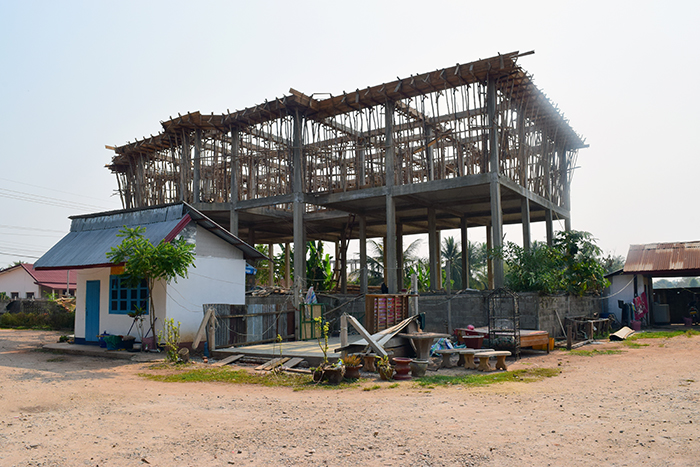
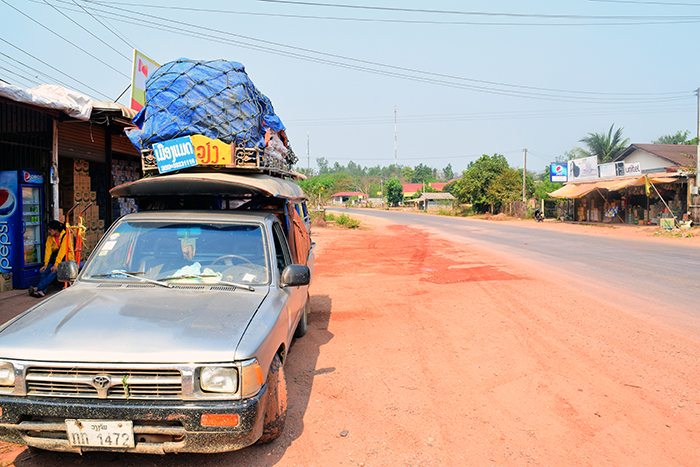
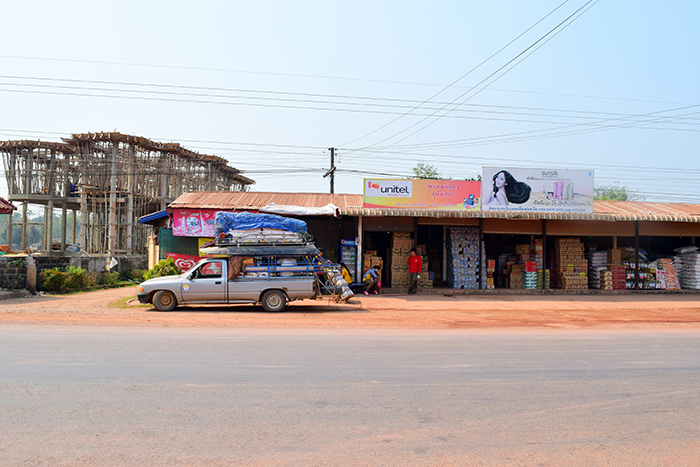
I stood by the bags, taking in the scenery, or lack thereof. There was what looked like a warehouse across from us, which was stacked high with colorful, plastic-coated boxes of soda cans, rice bags, beer cartons, and more. Other than Somchai, there didn’t seem to be any buildings around besides half-abandoned construction sites and small family homes. And beyond that was just fields and mountains. All civilization was focused on the slender stretch of highway that cut across these lands: a single, conspicuous charcoal line in the landscape like a Barnett Newman painting: flat planes of red dirt and green vegetation. The morning was silent except for the chatter of a few customers milling about in the minimart and the occasional rumble and creak of a passing vehicle, each stirring up a thick dust cloud as they passed. Right now, the highway was empty except for a few trucks headed toward Vientiane and a single red motorbike zooming up toward Nakam, trailing grit.

“I’m going to the toilet quick. Be right back and then let’s get going?” Jack said.

“Cool beans,” I said and he turned to cross the street back to Somchai. I screwed the lid back onto the water bottle and was leaning down to put it on the ground when I heard the screech and bang. 

I whipped around, just in time to watch the faded red motorbike swerve out of control past me and the rider thrown forcefully into the air. He flipped forward in an almost graceful loop, his eyes closed serenely and his body completely lax, and then fell hard onto the ground, hitting face first against the asphalt. Then nothing. He lay completely still. I looked back and saw Jack laying on his back in the street. He tried to prop himself up on his elbows and fell back down flat, groaning. I let go of the bottle and barely heard the sound of the plastic bouncing and rolling off the cement platform.

The biker still hadn’t moved. I took half a step toward him and saw blood was beginning to pool around his jaw and neck. I stopped, paralyzed with fear. Baby and Cody were running toward him. So were several other men from the minimart. They quickly surrounded him so I ran over to Jack, falling to my knees beside him.

“Are you okay?”

“Yeah. I…What? I was just looking out and what…” He tried to sit up again and was able to make it without falling back. I half-helped him stand, then dragged him out of the road, to the edge of the minimart platform beside our backpacks.

“Are you sure you’re okay?” He was a bit cut up on his arm and shoulder and his pants were ripped, but I couldn’t see any serious injuries. I was also more worried about internal ones. He was breathing heavily and curling up his body. 

“Yeah, ah, my stomach hurts. Fuck. The other guy. How’s the biker?“

I glanced back at the other guy. His face was still flat against the pavement. Everyone was just kind of staring at him, unsure what to do.

“He’s uh,” 

Dead, he’s dead. 

“Here, have some water. Please. Drink this.” I unscrewed the cap of the bottle and gave it to Jack, crouching in front of him, trying to block his view of the frighteningly silent scene. My heart was pounding and my thoughts were coming too fast to stop them, to tame them into reason.

If he’s dead-no. But if he is. Did I just see someone die? No. His family. He probably has a family. He was just driving and then… What happens if you kill someone in Laos? No.

Jack craned his neck to peer over my shoulder. And the water he’d drank immediately came back up, spilling across the cement and dirt. He sat there heaving, staring at the puddle in front of him. I couldn’t tell if he was puking or hyperventilating. I just rubbed a hand across his shivering back. 

Please let him not be dead.

In the middle of the road the blood pool was spreading: an ominous, thick dark stain on the asphalt. It was beginning to soak into the collar of the man’s camouflage windbreaker. I noticed one of his black work shoes had flown off. He was wearing a navy sock underneath. He still wasn’t moving. 

Oh, God. He’s dead. He’s dead. 

Cody and Baby helped several men flip the body over. Immediately, though, the men tried to sit him up. Someone shook him, as if that would resuscitate a corpse. Cody looked at me in a panic. I ran over, leaving Jack on the ground. 

“What do I do? No one here knows any first aid! They can’t move him! They keep tilting his head up and pouring water down his throat, and it’s just sitting in his mouth blocking his airway when he’s not even breathing. If he’s… What do I do? Nobody can tell what I’m saying!” Cody said.

“Just help him! You know first aid, you did the EMT class!” I said, also panicking. I had no idea what to do in this kind of situation. I learned CPR when I was twelve…but that was it. I imagined myself giving a very poor, gory version of mouth-to-mouth to this man, both of us choking on his blood, and knew I couldn’t help. I felt useless. Cody ran back to the man, bent down over him.

“He’s breathing!” Cody shouted. I felt a shiver run through my whole body. Thank God. Thank fucking God. 

I ran back to Jack, who was now being tended to by Baby.

“He’s breathing, Jack.” I said. I didn’t know how reassuring that could be though, because it was obvious the man was still unconscious. He was now just lying in the middle of the road on his back, his bike on its side beside him. I couldn’t tell how much of his face was injured for the mess of blood covering all of his features. His bottom lip was hanging off nearly entirely, and there was blood dripping down from his mouth, trickling in a syrupy river through his teeth. Four men picked him up, each by the end of a limb, and began to carry him to the side of the road. The biker’s head flopped loosely at the end of his neck. Cody leapt in and supported his head. One man carried the rider’s black pleather briefcase, which had blood and dirt stuck to it.

Once they’d reached the side of the road and placed his body on the ground, a young girl came out with smelling salts and a glass of water. Another man grabbed a piece of cardboard. They picked the biker back up, put him on the cardboard, and placed the salts under his nose. The man’s eyes opened, blinking back blood, and he moved slowly, like a bear first waking up from hibernation. His head twisted left, right, and his eyes were glassy with drowsiness and confusion. He lifted his right, gloved fingers to his now misplaced lip and touched it gingerly. It seemed like he couldn’t really feel anything; he moved his lip back to where it should be. Blood continued to drizzle down his face and another man helped him sit up.

“No, no! He needs to keep still,” I could hear Cody saying. 

It didn’t seem like anybody was actually doing anything to help the man with his wounds, protect him from infection, or even talk to him. Most people were just staring at him while he looked around, dazed and bewildered. His bike was still in the road, and that didn’t seem to concern him. Does he remember anything that happened? 

I ran to the lady from Somchai. “Hospital?” I asked. She shook her head. 

“Hospital?” I asked a man in the minimart. Nothing, again. I could hear Cody repeating it as well. I Google-translated it on my phone. 

“Ohngmo,” I said over and over to everyone who would listen, probably butchering the pronunciation entirely. Everyone shook their heads. Was there just no hospital here? We couldn’t take the man anywhere. Our only mode of transportation was a five kilometer walk away! Cody asked for my phone so he could translate questions to the man, the standard ‘do you know what your name is, where you are, etc.’ I wasn’t sure how he was going to figure out the man’s answers.

Jack had fallen backwards on the cement and was holding his side tenderly. Baby’s eyes were glued to the gory scene.

“Baby!” I snapped. “Make sure Jack doesn’t fall asleep. Jack, stay the fuck awake, okay? If you feel sleepy, sit up. You have to. And seriously, what happened? How did you get hit?”

“Yeah, I was looking out to cross and then I was thrown back…” Jack groaned out. 

“Where did you get hit? What part of your body? You need to show me.” 

Baby helped Jack sit up and he lifted his shirt. There was a bruise in the form of a straight line across his side, the same height and width of the bike’s basket. 

“My shoulder hurts too. And some of my thigh. And my ass. But mostly my stomach. It really hurts. And I feel nauseous.” 

Medical information spun around in my head. Where’s the spleen? Is that the stomach there? The kidney? How can I tell if he has serious internal bleeding? Nausea is really, really bad, right?

“You need to go to the hospital.” 

“No, no. I’m fine. Seriously. I don’t need to go to the hospital. Just give me some painkillers.” Jack said, referring to the unnecessarily massive supply of Panadol that I’d received the day before from the little countryside hospital.

“That’ll just mask your symptoms if you’re seriously injured.” I said.

Cody came running over. He was sweating and his eyes were big and round with fear. “They keep sitting him up! They can’t do that. He needs to stay lying down! They can’t tell what I’m saying. He knows who he is though and where he is. I just don’t have any supplies. They don’t even have gauze here, or a spinal board, or even alcohol so I can clean his lip.”

The iodine! I grabbed the little yellow squeeze bottle out of my backpack and handed it to Cody and he went to see if they had cotton balls at the minimart. All of the locals seemed to have lost interest in the scene; we were the only ones still paying the man any attention. Baby handed him some more water as Cody cleaned his wounds. I sat beside Jack, who was now breathing normally but not quite up to having a conversation yet.  

Jack’s black-and-white hat with its denim brim and the biker’s blue and black helmet were only a couple yards away from each other on the road. I stood up and walked over to them, picked them up. The helmet was missing a thick slice of plastic from the front visor. That must have been what cut his lip. The rider was middle aged, stout, and wearing full protective gear unlike most Laotian motorbike riders. (I’d seen pairs of nine year olds without helmets riding down the highway before.) How had he lost his helmet, the most important piece of gear? The only part of him that seemed hurt was his head and face. I hadn’t seen the helmet on him when he was flying through the air. It must have come off in the initial impact, meaning it wasn’t properly hooked on or something. 

I went over to the rider’s bike, picked it up and pulled it off the road. Several containers of jelly had spilled out of the basket. I placed them back in it. It looked like he’d been grocery shopping that morning, was just headed home from errands. That thought curled my stomach. 

We’d been sitting around after the accident for about thirty minutes now, just wondering if anyone else was going to do anything to help the guy. We couldn’t leave him; it felt wrong, as if we were fleeing the scene. Baby headed off to grab his bike, assuming he’d see us soon either still here at the minimart or back in Vientiane. Cody was now looking over Jack’s wounds as well, and I cleaned the cuts out with water and sanitized them with iodine. I placed a single, sticky bandaid over the one on his shoulder. It was the only one that needed it. 

A young policeman with a thick mop of black hair, a friendly smile, and the beginnings of a pot-belly rode up on a motorbike. His green uniform looked freshly pressed, but he was still sweating under all that polyester in the heat. Droplets trickled down his forehead. He began to ask us questions. At first he saw Cody’s and my wounds and assumed we were the ones that had been hit by the bike. He spoke barely any English, but enough to get across several questions about what had happened. And he waved down an open truck with several men in military uniforms to take the man to the hospital. 

We explained the situation, that Jack had been hit, where the initial impact had happened, and where the man and bike had landed. Several more policemen in beige uniforms appeared with a tape measure and white spray paint and they began to mark out the accident on the road. They drew a diagram of it all on a piece of graph paper in a ledger. 

Jack was led to the only full wooden table by the policemen and they asked him all the basic questions; name, age, occupation, nationality, where he was staying in Laos, why he was in Laos. There were now five police milling about, but only the man in green spoke any English. They were all writing things down in blue pen on the graph paper, but the symbols were complete gibberish to me.

A tall, gaunt cop, the least friendly of the bunch, asked for our passports gruffly. I wasn’t sure why they needed mine or Cody’s, but we handed them over. The cop in green asked us the same questions he’d asked Jack as his colleague copied down our passport numbers. We stood there for a long time, answering those same questions over and over. 

Name? “Cassia.”

Age? “Twenty-three.”

Occupation? “Journalist.”

Nationality? “USA.”

And repeat. Just sweating in the heat. I wondered how the biker was doing; I could still see his blood puddle drying into the road. The cops sat with Jack at the table for a while. One of them made fun of his full beard. 

I wandered back over to our backpacks and sat beside them, stretching my legs out. How long would we be here? One policeman followed Cody around the scene for the -nth time as he recollected everything again, scribbling down more notes in his notebook. Cody had been in the store when it all happened; he was just pointing out measurements on the road. Where Jack landed. Where the bike landed. Where the rider landed.

The cop in green appeared beside me, smiling, and sat down on the cement with me.

“Hello, your name?”

“Cassia.” He’d asked me this so many times, but I smiled anyway. His colleagues had my passport; I wasn’t going to piss him off. He told me his name. 

“How old?”

“Twenty-three. You?”

He held up his fingers. Twenty-four. “I learn English now seven months.” He said. 

“It’s really good!” He grinned at that, scooted closer to me on the ground.

“Are you married?” 

“No. But boyfriend.” I pointed at Cody. 

“Very beautiful,” he said. He looked me up and down in a way that made me hug my knees to my chest. 

“Ah, thanks…” I said. Is he really doing this? At the scene of a nearly-fatal motor accident? Is he really hitting on me right now under these circumstances?

“How many in your family?”

“Um, like, five? Mom, dad, sister, brother, and me.” I held up a finger for each person as I named them off. He nodded; apparently that was a good answer. He looked at me expectantly.

“And um, yours?”

“Four. Mom, dad, sister, me.” He counted them off on his fingers as well. 

Cody came over then. I think he could sense my discomfort from ten yards away. 

“Very strong! Good!” The cop said, pointing at Cody and nodding at me. I nodded too, let out an awkward chuckle, and the cop got up, dusted off his uniform, and walked back to his colleagues and Jack. After a moment, they called Cody over and made him and Jack sign and date something handwritten in Lao. It looked like some sort of witness statement. Then Cody and I went back to our backpacks.

“What’s going on?”

“I don’t know.”

We sat there for a bit longer before I heard Jack’s voice raising at the table.

“Can I have my passport?” He was saying, loudly, almost panicky. A pause. I could see the back of the policeman shaking his head. 

“Why can’t I have my passport?” More head shaking. “Wait, where is he going? Why is he taking my passport?” A cop got on the injured biker’s motorbike and rode off down the highway.

Cody and I ran over. We did not want to anger these cops; I didn’t know what powers the cops had in Lao. 

“Ah, where is he going?” I asked the English speaker.

“The police station. It’s okay! Do not worry!” He smiled.

“Well, can we have our passports back?” I asked, suddenly very aware that my passport was in the hands of the gaunt cop, who was glaring at me. I couldn’t tell if it was his resting face or if I’d pissed him off by existing.

“No, no. We all go to police station. Next village.” The cop in green told me, still smiling.

“Uh, okay.” I said. There wasn’t much else to say. Cody, Jack, and I followed three policemen into a plain gray van and sat in silence as we rode to the station in the next village, passing nothing but open faced huts, curious faces, and green land between.

The Motorbike Chronicles, Part II: Crash


Location: Nakam, Laos

I’m in a teeny village about forty-five miles from Vientiane. It’s only eight o’clock at night but the sun is down, the dirt roads are pitch black and empty, and there’s no food, no water, and most importantly no booze available anywhere. My friends and I are lucky we were even able to find a guesthouse on this less traveled path, and even luckier that both rooms have working air conditioning and one of them has a shower. 

It’s been one of those days you replay in your head a thousand times over, whether you like it or not, and I’m having one of those moments where you don’t know where you stand yet about the day’s events, maybe because I’m in shock or maybe because I’m just happy to be alive or maybe both. And it’s just another day in my backpacking adventure; that’s what I keep telling myself, anyway.

Last night, I woke up to a feeling I unfortunately know well: the almost-ticklish, warm seeping wetness of a nosebleed. I’m used to these midnight surprises; it happens to me when the seasons change or when it’s too dry out. But this particular one was unusual for the amount of blood that poured constantly out of my left nostril for at least twenty minutes. But it finally subsided and I flipped over my now-bloody pillow and tossed and turned until my alarm rang. I don’t believe in omens. Or at least I didn’t.

This morning, Cody, Baby, Jack and I had had our secondhand motorbikes for two days, and the novelty had yet to wear off. Cody and Baby practiced the most, scooting unsteadily up and down our hostel’s street in the middle of the night while everything was quiet and the only people left out were hookers on motorbikes, hunting for potential customers. After my initial fears of crashing upon takeoff subsided, I found that driving the bike was incredibly liberating. However, I still wanted way more practice before we hit the road. Unfortunately, our friends were pushing to move on to northern Laos and we had to cut preparation short. 

Barely forty-eight hours after our initial introduction to motorbike mechanics, we packed all of our shit up, strapped it onto the backs of the bikes, bought four extra large bottles of water and a handle of Lao Lao, and set off for Luang Prabang, a two-day’s ride north through mountains and countryside. After we left Vientiane, the next village with flushing toilets would be at least a day’s ride away. Otherwise, we’d be passing through only farming communities and nature. 

Cody and Baby drove while Jack and I rode double on the backs. I made a fleeting comment about the importance of servicing our bikes before we left the city, but to no avail. As we pulled out of the gas station, Baby popped a wheelie, but quickly regained control and composure. Cody stalled several times at stoplights, but he seemed to be getting the hang of manual gears. We were on our way for better or worse.

Cody and I rode in front; I was in charge of directions (aka don’t veer off the only highway for the next 90 miles). When we’d left the traffic in the city behind and entered the dusty countryside, I couldn’t stop thinking about Baby’s definition of the bike as “freedom.” As cliché as it sounds, it really felt like I was flying. Unlike traveling in a cramped bus, peering through dirty windows and cradling my backpack in my lap, I was out in the Laos countryside, able to get a good look at the landscape around me. The afternoon sun beat down on me but the wind kept me from becoming soaked in sweat. Even though the heat should have been overwhelming, I was cool in my jeans, black tank top, and thick skater helmet. And I was too busy taking in the lush trees, straw-topped huts, herds of cows, and local life to concentrate on any discomfort, anyway.

But that joy only lasted a little while. We’d been riding for about an hour. Cody had gained a newly discovered confidence at the wheel and we were heading full speed down the paved road. Then, just as the asphalt crumbled into a gravel patch, a middle-aged woman on a shiny beige scooter cut us off and drifted left, then right, breaking. 

We were going too fast to stop in time. 

Everything happened in slow motion. Her taillight flashing red. Cody swerving sharply to the right, our bodies jerking with the movement. The gravel crunching below the wheels and the sharp squeak of Cody hitting the breaks. Too fast for the weight of the bike, for the speed we were going. Then the gravel rushing up at us and under us and around us. My body being flung into Cody’s, my face mashing into his shoulder blade, fingers wrapped in a death grip around his iPhone in my left hand. And the sound of skin and metal skidding across gravel, ripping an angry path through the red grit and rocks. We skidded forever, flesh tearing against rocks, and I choked on the cloud of dust around us. 

When we did stop, I still hadn’t processed that we’d fallen. Only that it was strange that there were rocks everywhere and the white of Cody’s tank top under my face. And from the fog of my confusion, Cody’s voice, muffled by his helmet. Under me.

“Are you okay?” 

Why wouldn’t I be? 

“Cass, you okay?”

Holy shit, we crashed. Oh fuck, oh fuck.

“Yeah, are you?” I was surprised by the steadiness of my own voice.

“Yeah. Good, we’re okay. We’re okay. Get up.” Cody said. He let out a sigh of relief. I pushed down to lift myself up, my palms against the earth, and I couldn’t move. A sharp pain twisted up my right leg. 

“Cass, get up.”

The realization hit me hard. “I-I can’t. The bike is on me.”

We were completely pinned down. I could hear the soft crush of rubber soles on gravel as someone ran towards us. And then came a gush of air and a release of pressure as the bike was lifted up off my back. Hands grabbed my shoulder and torso, rolled me into a sitting position.

My backpack felt heavier than before. I lifted myself into a crouching position. I was still holding tight to Cody’s phone and I let go. It slipped out of my fingers and onto the ground. Cody had pulled himself up, was standing. 

Oh, thank God. We’re okay. 

Hands dragged me up so I could stand and I found myself facing Jack, who looked way more freaked out than I felt. I shifted from leg to leg, testing them out. Phew, my leg isn’t broken. I’m fine. Then I looked at Cody and my stomach dropped. Blood was pouring from his knees, forearms, and the palms of his hands, trickling down his arms and legs in dark streams. His basketball shorts and tank top were ripped all over and stained a dirty orange. He stood in front of the bike, assessing the damage. 

“Are you okay?” Jack’s voice. Everything sounded far away, like I needed to turn the volume up.

“Yeah, yeah, I’m fine.” I wanted to take my backpack off but that seemed like a lot of movement and I wasn’t sure I could handle it. My laptop and camera were in it. I hoped they hadn’t broken. I stared at the ground for a moment, wondering whether I should check them out. It was too much effort. Baby had run over to Cody by now, was pulling our bike off the road so traffic could get through. Jack reappeared in my vision, holding a water bottle. 

“Are you okay?” He asked again. I nodded. I could tell from the look in his eyes that he kept asking because something was wrong. But I felt fine, just a bit numb.

I checked myself out. My jeans were ripped in one knee and the patch of skin showing was bloody. A slender flap of skin was dangling from my left thumb and the bottoms of my palms were both pretty cut up and bleeding. I noticed red was dripping down onto the ground beside me and when I lifted my right arm, saw the entire underside, from wrist to elbow, was wet with blood. But I couldn’t find where the wound started or ended. 

Jack uncapped his water bottle and poured liquid down my arm. Crimson rained down on the dirt.

I noticed Cody was walking away with a local man, back the way we’d come. A Laotian woman waved hello to me.

“Do you need to go to the hospital?” The lady asked me in broken English. 

“I don’t think I need-“ She was staring at my forearm, her eyebrows furrowed. 

“Okay. Yeah, hospital.”

She and her daughter, who also spoke English, accompanied me down the road to the hospital, a one-story, two-room white building that was thankfully only a few hundred meters away. When we arrived, she knocked on a door and it slid open, revealing several beds and sleepy-eyed nurses dressed in white uniforms. The woman told them what happened as they brought us to the next room, which was empty except for a chest of drawers, a metal desk, several chairs, a folding slider, and two stretchers fitted with plastic green mattresses. The woman’s daughter told us to take off our shoes and lie down on the beds.

Nobody seemed surprised that two foreigners had wandered in beaten up from a motorbike accident.

Nurses wearing medical masks and holding squeeze bottles filled with clear liquid surrounded us. When they dabbed at my wounds with what must have been some sort of hydrogen peroxide, bolts of burning pain leapt up my limbs and I cried out. I glanced over at Cody’s bed to distract myself and saw that the nurses had bunched up his shorts and shirt and were hard at work cleaning him up; his entire right side was cut up and bloody with road rash. It looked agonizing.

They saved cleaning my forearm for last and I lay with it propped up, blood dripping onto the bed. My thoughts were jumbled. At least my black tank top won’t stain. Don’t look at your arm. I can’t believe they ripped my jeans more to clean my knee up. They’re ruined. Don’t look at your arm. I hope nothing’s broken in my backpack. Just don’t look. I could hear Cody hissing in pain on the other bed.

The little girl and another boy, maybe the son of one of the hospital staff, stood at the end of my bed. They stared wide-eyed as two nurses mopped my arm up and swabbed iodine onto it. I muffled a scream. When I finally chanced a glance I immediately wished I hadn’t. Whatever was going on there was deep. I could see the white of my radius peeking out from one of the gashes and I felt nauseous when I realized how much of my skin was missing. I heard Jack behind me ask in a whisper if I needed stitches and his relieved “good” when the nurse told him I didn’t.

When Cody and I were bandaged up, we were handed plastic baggies of medicine. Painkillers, iodine, antibiotics, extra gauze, and silkworm extract for inflammation. The total bill was only $20. I’d forgotten that I didn’t have travel insurance and was relieved when I saw that.

I walked across the street to a vendor and bought Cody and myself orange sodas. We’d lost enough blood that a boost in sugar would be beneficial. Cody was freaking out a bit; he was obviously still scared shitless about what had happened and said the bike was probably destroyed, anyway. We were in the middle of nowhere, though, and after a bit of group discussion, decided to check the bike out and if it wasn’t too damaged, see if we could still make it to Vang Vieng, the next village, by nightfall. We could ditch the bikes there and grab a bus the rest of the way to Luang Prabang.

When we went back to the bike, the headlight was hanging off by the wires and the ignition box was tilted. But after some masking tape adjustments and a couple test kickstarts, we found out it still worked. We rode on and made it through about four hours down through the country before things got worse.

Cody and I were just riding up our first mountain when our bike started dropping gears and stalling. I got off and Cody kickstarted it again. It revved, got up to second gear, and dropped again as soon as it started up the slanted road. We repeated this several times to no avail. It wasn’t able to take the weight of two passengers and two backpacks. We were stuck.

It was nearly sunset and the reality of the situation was beginning to set in. It was important to only ride in the daylight as now neither bike had a working headlight (Baby’s had never had one). We had to turn back and find a mechanic and shelter before dark. After a panicked drive through the fading light we found ourselves in a village with a mechanic who not only fixed our bike, but even made the headlight work. But when we drove back down the road in the dark, Cody said he couldn’t see a thing. The terrain, strewn with pot holes, gravel patches, and the occasional stray dog, was already treacherous to navigate. And now there was only moonlight to guide us and the weak yellow gleam of our single, flickering headlight to protect us. Cody pulled over nearly immediately; we’d either have to set up to sleep on the side of the road or walk. So we decided to park the bikes by a gas station and walk, attempting to use the Google translate on my phone to ask locals for the nearest hotel or guest house.

Then, as Baby untied the packs, disaster struck again. The bottle of Lao Lao, nestled amongst our belongings, slipped from its nook and plunged to a quick death, smashing against the rocky ground. We really couldn’t win, could we? We tramped along the side of the road and people on porches stared; most tourists buy tickets for night buses that pass by these parts in the dark and don’t stop. Nobody spoke English out here, there was no Google maps that worked on these empty roads. We were strangers lost in the middle of nowhere.

After much hand gesturing and several botched translations on my part, a local managed to get across to us that there was a guest house in the next village over, Nakam. Only about five kilometers away. We were relieved and prepared to do the walk without question; everyone was tired and aching but not delusional. Sleeping on the side of the road was a worst-case scenario. A 5K trek was much better, if far from ideal. 

And then our luck changed, if only momentarily.

A pick up truck driving by us pulled over. The friendly little woman inside asked if we were headed to Vientiane. She wrinkled her face in confusion when we told her we just wanted to make it to Nakam, but pointed to the back area of her truck. Get in.

She drove us right up to the entrance of Somchai Guesthouse, and when we tried to offer her money, she turned it down. I couldn’t see her face clearly in the dark, but I could tell she was smiling. Her voice was cheery, bright. We referred to her as Our Guardian Angel from then on. 

Somchai was quiet. I think we might have been the only customers there. I couldn’t believe our luck when we found out they had two available double rooms with air conditioning, and one of them had a running shower. It was around seven when we threw down our bags; no one had eaten since 11AM, when we’d taken off from Vientiane, and we were all starving. We’d also run out of water and needed to replenish it ASAP. Jack went on a hunt for food, water, and booze, but returned forty-five minutes later empty handed. He’d walked all the way up and down Nakam and hadn’t found a single store or restaurant, only a group of drunk locals who goaded him into taking a shot of mentholated spirits so strong he gagged and then sent him on his way.

I helped Cody remove his gauze and tape and when I saw his wounds, I cringed. They weren’t deep, but they covered large areas of his joints, which meant it would hurt for him to move while they healed. He also began to complain about his right ACL, which he’d recently sprained. Stabbing pains were shooting through it whenever he bent it. He hadn’t noticed on the bikes because of the adrenaline rush, but now he was very aware of the injury. When he hopped into the shower to clean out his scrapes, he swore when the cold water hit them.

“Fuck, ow.” He hissed, “SHIT OH MY GOD FUCK AHH.” 

I felt queasy as I heard his cries from the shower, but I didn’t understand the torment he was surviving, not yet. When I removed my bandages, I saw that several areas were blackened by either dried blood, dirt, or dead skin. I’d have to clean them out, thoroughly. My arm was still bleeding, too, which was worrying.

When it was my turn to shower and the water hit my palms and forearm I screamed and ducked out of the blast. It felt like everything was on fire, sizzling and burning worse than I had ever imagined pain could be. I sobbed as I rubbed soap into my wounds, the pain so intolerable my vision going black and my knees shaking. And later when Cody poured iodine on them, Baby held a towel to my mouth I could bite down on and scream into. When the pain had finally dulled from acute to just throbbing, I went to take a photo of Cody’s and my battle wounds, only to find my phone was missing. After a short flurry of a search, I realized exactly where it was. I’d left it in the back of the pick up truck. Jack sent several text messages in broken Laos to Our Guardian Angel, promising money for return of the phone, and we waited.

Cody and I re-wrapped ourselves up and sat on the bed, trying to figure out a new game plan for the next day. We were still half a day’s ride from Vang Vieng, and there’s no way we could make it up the mountains with four people on those bikes. We were also half a day’s ride from Vientiane, which could be done, but which we didn’t have a rider for. Cody refused to drive the motorbike, again. Jack and I both refused to drive as well, very aware of our limited practice on them. 

Baby didn’t want to give his bike up. He was already pretty skilled, a natural behind the wheel. But he couldn’t ride to Luang Prabang alone. It would be at least a couple days’ ride through dangerous mountains. No way would we let him undertake that, especially not after what we’d just been through.

We decided that the next morning, Baby would ride his bike back to Vientiane while the rest of us hitchhiked. Baby would sell his bike in the capital city and from there we would all catch a bus up to Luang Prabang. In a half-hearted burst of group cheer, we all put our hands in the middle, lifted them up and called out, “Go team!”

And then another awesome thing happened; the woman from the pick up truck called Jack’s phone in response to his messages! He handed it to me and I ran outside to the owner of Somchai, a bubbly woman in her mid-twenties. But she didn’t speak a word of English. Neither did her younger brother. So they were given information by the woman that couldn’t be relayed back to me. Finally, the owner called her daughter, who spoke limited English, and asked her to translate. The daughter then wrote out the woman’s address on a piece of paper and sent a photo of it to Somchai’s owners. It turned out Our Guardian Angel lived in a district only forty-five minutes outside Vientiane, and was happy to meet me there to return my phone the next day! 

That night I fell asleep watching Mean Girls dubbed in Laotian on the 1990’s gritty television screen attached to the wall above my bed. However, I didn’t rest long. Cody couldn’t find a comfortable position with all his wounds and I ached too much myself to feel relaxed. So here I am, writing this at 4AM. We’re headed back to Vientiane in a few hours. We’re going to hitch a ride there and hopefully get bus tickets for the next day. And leave our motorbike dramas behind us.

Expenses

  • Full tank of gasoline: $1
  • Medical bill: $20
  • Somchai Guesthouse: $5 
  • Extra gauze, tape, and bandages: $1.25
  • Mechanic: Free, because he pitied us useless tourists

Travel Tips

  • When you ride a motorcycle, always wear protective gear. Enough said.