Why You Should Visit Hoa Lo Prison Museum

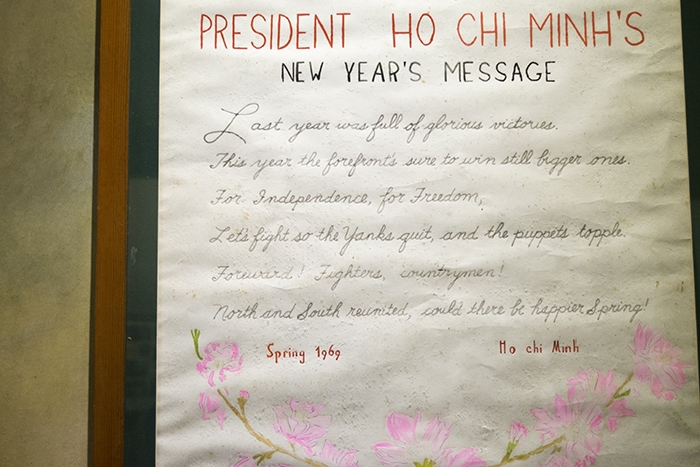
An artifact from Hoa Lo Prison Museum written and decorated by American POWs during the Vietnam War.

An artifact from Hoa Lo Prison Museum written and decorated by American POWs during the Vietnam War.

Location: Hanoi, Vietnam

We’ve all seen examples of blatant propaganda throughout history. A couple of the most  famous ones that come to mind are the “I WANT YOU” Uncle Sam posters that the US government commissioned to  recruit soldiers during World War I & II and “Reefer Madness,” a (now) cult-classic  film first funded in the 1930’s by a church group hoping to scare kids away from using marijuana. Today, when we analyze the language used in these media messages,  whether it be “drugs are bad” or “support your country,” it all seems obvious. And it’s hard not to look at examples of conspicuous propaganda and think that that kind of misinformation can’t possibly hold the same power in the age of Google. And I have to admit, that’s something that I, as an American and a millenial, have often taken for granted; that my liberty to access information is pretty much unlimited.

But that’s the thing about modern-day Internet censorship in communist countries like China, North Korea, Cuba, and Vietnam: misinformation can hold a lot more weight when you can’t fact-check it. And I encountered this culture shock not only in expected ways, like trying to access different stories on The New York Times or The New Yorker, but also in national monuments and places built specifically for informing the public about historic events, like the Hoa Lo Prison Museum.

A brief history: Hoa Lo Prison was first built by French colonists in the late 1800’s, back when Vietnam was still under European rule.1 They used it as a holding facility and execution center for Vietnamese prisoners, most of whom were charged with political crimes. The prisoners were shackled to wooden planks by their ankles in dank, smelly, overcrowded dungeons. Many were tortured in skin-crawling fashions; one of the most memorable was commonplace,  a method in which several people were stuffed into coffin-like, barbed-wire cages in the prison’s courtyard and left to cook under the sun for hours.

Both men and women suffered in this haunting place. Heads were chopped off during executions and displayed in woven baskets to the prisoners. Many starved to death.  And this was no temporary holding area. The prison remained open, it’s numbers growing from a few hundred to over two thousand, until 1954, when the French left Hanoi and Vietnam became the Democratic Republic of Vietnam.1 Several  revolutionists, Vietnam’s kind of “founding fathers,” were kept in this prison for over a decade.

The prison was shut down from 1954-1964, when it was reopened during the Vietnam War (or the American Invasion of Vietnam, depending on your stance). It was here that the North Vietnamese Army held captured American prisoners of war (POWs) and interrogated them.

Now, this part might sound familiar if you’re a bit of a history buff. The Vietnam War was the first war the US entered where the on-the-ground violence was heavily photographed and videoed. This widespread media, one that documented the real horrors of the war for the first time,  spurred controversy and anger from much of the general population and led to worldwide protests against US military involvement in Vietnam. But what you might not know is that the North Vietnamese army had its own plan to influence the general public. And that plan unfolded within the walls of Hoa Lo Prison.

The idea was simple: convince POWs, through whatever methods necessary, to speak against the US government and praise the North Vietnamese and their treatment at Hoa Lo. And “whatever methods necessary” quickly fell under the category of “cruel and unusual punishment,” also known as torture. It was in this place, one nicknamed the “Hanoi Hilton” by captured soldiers as an ironic reaction to the poor living conditions and abuse they suffered, that one of the most famous attempted-propaganda tapes from the Vietnam War was made. It’s a grainy, poorly cut film of a soldier speaking in queer stiltedness to the camera, answering questions during a press conference. And while he’s speaking, he blinks out “torture” in morse code.2

Back to the present: So here I am, meandering through Hoa Lo’s gatehouse, the only part of the prison left standing. There is, at best, an unsettling atmosphere within the yellow-painted, cracked walls. It’s the kind of feeling that’s to be expected when you’re in a place where you know many, many people have suffered, been tortured, and killed. And the museum has made that very obvious in the first buildings, which are dedicated to the horrific treatment of Vietnamese prisoners by the French.

There are life-size, wooden sculptures of prisoners in shackles; they all look half-starved, crippled, and there is an endless sadness painted onto their carved eyes. Some statues stare out windows while others speak with their bedmates. These figures have glass boxes of evidence beside them; old notebooks and copies of communist manuscripts that revolutionaries hid while imprisoned. All the plastic information plaques here describe the conditions as “horrible,” “inhumane,” and “unbearable,” and the prisoners as suffering but, because they believe in the spirit of communism, able to stay “resilient” and “strong.”

It’s true that the conditions were inhumane and though the language is obviously biased, I let it go. What could be the harm in people reminding themselves that their ancestors stayed strong even as they suffered? Who’s to say these men and women didn’t keep hope because of their strength of community?

Next, I enter the part of the museum dedicated to the Vietnam War. The exhibit is mostly images of POWs during their time in Hoa Lo. There’s a group of prisoners playing basketball here,  another of men lined up for food there. One  is a gritty, blown-up black-and-white photograph of John McCain (yes, that Senator and 2008 presidential candidate). It’s a famous photograph. McCain, then just a fighter pilot, was  shot down during his tour in the Vietnam War. In the image, post-crash and capture, he is young- his hair hasn’t turned its signature snow white yet. He’s lying on a stretcher as a Vietnamese man in scrubs runs a stethoscope over his chest. His arm closest to the camera is taped up in a sling, his eyes are wide, his mouth is half-open, and he’s wearing an expression of excruciating pain and fear. He stares out of the frame at something or someone beyond the camera.

McCain has attested that when he was shot down, he fractured both his arms and one leg in the crash, then after he was dragged to shore by several North Vietnamese soldiers, they beat him with a rifle butt and slashed him with a bayonet. When he arrived at Hoa Lo, the prison staff refused to treat his injuries, instead interrogating him and assaulting him until they found out his father was a high ranking military officer. It’s reported that McCain lost fifty pounds during his first two months in Hanoi. This was only the beginning of several miserable years of capture for McCain, which included more torture and two years in solitary confinement. The injuries he sustained during this time left him permanently weakened.3

But the caption inscribed on the panel before me, the one hung so precisely below this image, describes the excellent treatment of American prisoners and how the North Vietnamese army used all resources at their disposal to make sure they were looked after. How all prisoners were regularly visited by doctors and kept in good health, including McCain.

I’ve been standing in front of this image for a long time and the museum is bursting with hundreds of visitors. It’s hot, crowded. The sun is shining down through the open windows on my back and I’m sweating in my tank top, but I’ve got goosebumps. A woman walks up to my left, spends just enough time to read the plaque and take in the photograph, then moves on without a second glance.

She knows these are all lies, right? I can’t be the only one here that’s shocked. Everyone knows that McCain almost died in captivity and that these are outright lies...right?

I panic. I have the briefest, wildest impulse to grab the woman’s shoulder as she walks away, to whirl her around and ask her. But it fades just as suddenly.  I can’t just freak out on a random tourist over this piece of propaganda. What am I going to do if she doesn’t know what I’m talking about? Lecture her on the human rights violations committed by the Vietnamese during the war until I’m escorted out of the building by the museum’s security guards and (most likely) into a police car?

So I’m stuck. I move on to the next image, but a darkness has settled over me. I’d also visited the Women’s History Museum earlier in the week; there was a floor dedicated to the hundreds of thousands of women that were drafted into the war effort against America. I had previously never read about the importance of the infrastructure built by these women during the war and had been swept away by the images of brutal manual labor in front of me. I came across a section with images of particular female wartime heroes and their distinguished awards. One title that many drafted women soldiers held was the “Anti-American Hero Award.” It was an honor awarded to soldiers that killed many Americans.

No matter what your stance is on the Vietnam War, it’s sinister language. It’s no longer about supporting Vietnam or standing behind your country. It’s specifically rewarding those who kill Americans. It’s targeted. It’s something that would be considered bigoted and overwhelmingly negative in the United States. I can just imagine the protests over an “Anti-Vietnamese” hero award. Now, I know it’s not that simple. America hasn’t dealt with another country attacking its people on its land - not like Vietnam has. However, as an American citizen, I would heavily question, if not fully condemn, that kind of language. I also know that I feel that way because I have the right to, the ability to question my government’s choices. I don’t see that in Vietnam and I wonder how many people believe the propaganda that’s placed in educational institutions like national museums.

And it’s for this reason that I recommend visiting the Hoa Lo Prison Museum; it’s a cultural experience and total mindfuck, especially if you’re American. And it’s good to remind yourself sometimes of the freedoms often taken for granted.

1 Logan, William S. (2000). Hanoi: Biography of a City. University of New South Wales Press. ISBN 0-86840-443-8.pp. 67–68.

2 "Eyewitness". Archives.gov. Retrieved 2012-11-19.

3 Nowicki, Dan & Muller, Bill. "John McCain Report: Prisoner of War", The Arizona Republic (March 1, 2007). Retrieved November 10, 2007.


The Sailor Girl Cringe-Tastrophy

Location: Hanoi, Vietnam

Warning: this is a cringe-worthy story.

Cody and I had just finished dinner; a fancy affair, about $10 each, at a French cafe that we’d even dressed up for (read: I was wearing my only skirt and he was had on jeans instead of his usual basketball shorts). We were wandering down one of the side streets near Flamingo Hotel (whose large, fancy metal sign actually now read Lamfingo Hotel for no apparent reason). We’d passed plenty of karaoke bars, but just wanted a drink without having to listen to amateur pop stars belting Vietnamese love ballads. That’s when I spotted a cute place down a quiet lane: colorful stained glass, opaque windows, a flashing orange sign that read “lounge” in curly script, and a fake cherry blossom tree dangled over its vintage wooden door. 

“Let’s check this place out!” A lounge sounded lovely; I imagined comfy couches, multicolored cocktails, mood lighting, and low-key electronic beats just ambient enough to enhance a drunken conversation. I bounced up to the door, gave the knob a twist, and swung it open. 

But instead of a dimly lit, trendy room filled with people in slinky black outfits sipping Martinis, I found myself staring at a very plain, florescent-lit, wooden bar. And all the barstools were occupied by young Vietnamese women wearing different versions of the slutty sailor outfit girls wear on Halloween back in college in the United States.

Twelve pairs of curious eyes turned to me. Most of the girls were on their phones or chatting with each other and I could see wide eyes and dropped jaws across the room.

“Oh,” I muttered. I shut the door and stepped backward down the steps, falling into Cody’s chest. He had been right behind me and seen the whole scene.

“I don’t think that’s a lounge,” I said. 

“Nope,” he said. 

“Did you see the sailor outfits?” I asked.

“Yeah,” he laughed. 

“I kind of want to take a picture - do you think I can?” 

“Yeah, but really quick. It’s weird.” 

I ran up the steps, opened the door again, holding Cody’s iPhone to my chest so it wouldn’t be visible that I was photographing the room, and slipped the door open. Once again, the whole room turned toward me. I snapped the shot and closed the door, bounding back down the steps like I’d just committed a ding-dong-ditch. 

We power walked away, Cody a few paces ahead of me in the darkness. Then I heard the door opening again. I turned to see a sailor girl poke her head out and wave at me. I stopped and she came out of the bar. She had a little purse tucked under her shoulder and she walked up to me, asked me if I needed help. I don’t think she saw Cody ahead of me; he hadn’t heard the door and was now halfway down the block, hidden in the shadows.

“Oh, I was just looking for a bar,” I said, blushing. I noticed that I could see the top of her head; she couldn’t be taller than five feet. Her straight, black hair was cropped short into a bob and on one of her cheeks there was a trail of thin, dark, raised scar tissue that broke her otherwise clear complexion. 

“Well, we have drinks. And music. You can drink here if you like. No problem!” She stared up at me, her eyes gleaming earnestly. She wasn’t wearing any make-up, which I thought was strange for a hooker. I couldn’t tell how old she was. Maybe my age? The shiny, blue polyester of her uniform reflected the glow of the flashing sign above us.

“Well, um. Let me just ask…” I called out to Cody in the dark, waving him back. But when he appeared from the shadows, the sailor girl pursed her lips together, peering past my shoulder at his figure. 

“Oh, it’s 500,000 a girl.” She stated matter-of-factly. My eyebrows raised. Oh, there it is. 

“No-no thanks? We’ll just go somewhere else.” 

“Okay!” She waved at me as I walked away and then hopped back up the steps. Her pleated skirt bounced with her movements and the lounge sign flashed again. There was a big smile on her face that glowed a warm orange under the light, her scar casting just a sliver of a shadow across the arch of her cheekbone. 

Expenses: 

  • Fancy French dinner for two with a bottle of wine: $20
  • A sailor-themed Vietnamese hooker: $25

Travel Tips:

  • Beware of anywhere labeled “lounge” with opaque windows. It’s definitely a brothel. 

Brides to Be: A Photoshoot at the Mall

Location: Hanoi, Vietnam

The first night I passed the mall on the edge of Hoam Kiem Lake, I thought I'd stumbled upon a photoshoot for a bridal gown collection. However, after multiple evenings of witnessing different couples tramping around in tuxedos and gowns, I realized that these are all actually separate, legitimate wedding parties. For reasons unknown to me, it's common for these newlyweds to commemorate their special day in front of the golden Dior signs that frame the mall. And it's so popular that couples often wait in line behind other bridal parties for their perfect shot. 

A Vietnamese Paris with a Touch of Hectic

Location: Hanoi, Vietnam

I’d wondered if I’d like Hanoi. I’d heard plenty of praises sung by the backpacker crowd; many regarded it as very quote-on-quote cool and as somewhere they could even see themselves teaching English for a year or two. “Quaint” was an adjective thrown around a few times. I imagined it had to be a pretty hip spot for so many young Westerners to not only enjoy visiting, but actually want to live here. But then again it was another big Southeast Asian city; the clusterfucks of Bangkok and Phnom Penh loomed in the back of my mind. 

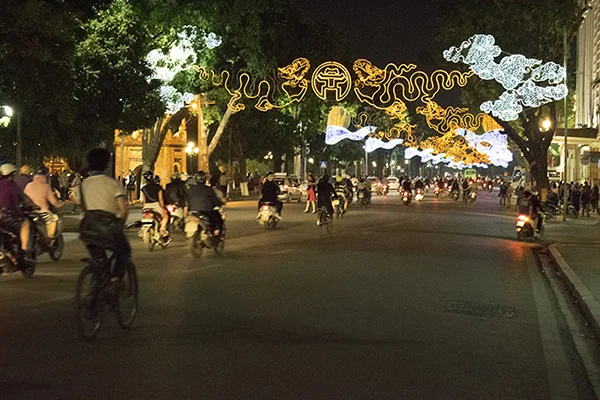
It turns out that Hanoi is similar to most cities in the best ways: the rush of zoned-in pedestrians, the overlapping, diverse neighborhoods, the fashion-forward shopping scene, the endless array of street food, and the always-pumping nightlife. But it has another edge to it, the one that emits that special quaintness that so many tourists find desirable: the strangely romantic contrast of flashy and modern glasswork beside crumbling, pastel-painted, should-be-condemned architecture on every block. Trees sprout from most sidewalks, and train tracks twist through city center, cutting a rusty river through the backyards of houses and apartment complexes on either side. The French architecture is delicate and falling apart; curled metal grates chip paint, wooden shutters are missing sections, and wide balconies have cracked glass windows. But they still give off just a hint of old Paris, even if all the signs are written in Vietnamese characters.

A pulsing energy radiates from the dirty concrete; it’s one that quickens my pace as I weave through the crowds, street chickens (seriously it’s a thing), plastic furniture, playing children, and parked motorbikes that compete for space on the sidewalks. It’s an extreme dose of that good ol’ center-of-the-world city vibe. However, here in Hanoi the sense of purpose is replaced with a desire for survival. It takes all your energy just to focus on NOT knocking other people over as you walk. And crossing the street is a real-life game of Frogger. 

I’ve never seen anything like it. The avenues are packed from edge-to-edge with motorbikes of all shapes and sizes. When you prepare to cross, you check both ways for cars, and if there are only motorbikes toward you, you just step out into traffic. That’s right. You don’t stop, you don’t look at them. You just stay straight and steady and cross the street. The bikes will slow down and adjust for you. Honestly, though, I can’t get the hang of it and have panic attacks every time. I just don’t have that level of trust in other humans, in their ability to break. Often, the only way I make it across without stopping suddenly and almost causing a traffic jam is by closing my eyes and just going, as strange as that sounds. But others just laugh at me and tell me I’ll never survive Saigon, which is supposed to be twice as hectic.

Good Morning Hanoi

Location: Hanoi, Vietnam

Cody and I arrived at Hanoi’s bus station just after dawn broke. The pale tones of twilight softly pooled in from the east, dissolving yet another night into day. I was restless, sore, and exhausted after twenty-four hours of travel. There is no amount of over-the-counter Asian-generic-Valium that can undo the physical weariness and boredom of that much movement, that little rest. As we stretched and gathered our backpacks from the small hill of taped-up cardboard boxes and battered luggage thrown from the trunk of the bus onto the concrete, Cody realized his beloved spearfishing gun was missing. He’d attached it to his bag by the side straps, the sharp end pointed down (he’d lost the black cap, so this was his last-resort safety measure). 

He questioned the two weary men unloading the bottom of the bus. Both shook their heads and one held out his hands, as if to say, “No English.” Cody bent down, searching the depths of the now-empty compartments but to no avail. It was gone. Someone had stolen his gun and there was nothing to be done. 

I stepped away from the station and soaked in a new world. There was none of Don Det’s mugginess here in northern Vietnam. The morning was crisp and the bikers weaving in and out of traffic wore colorful windbreakers. Everything was so alive; the streets were filled with power walking pedestrians, speeding vehicles, and the air was cluttered with honking, voices shouting, the screech of shop owners rolling up metal awnings. After spending so much time in Laos, a country whose largest cities can be walked end-to-end within an hour and whose population probably equals its number of livestock, I was thrilled by the flood of bodies. 

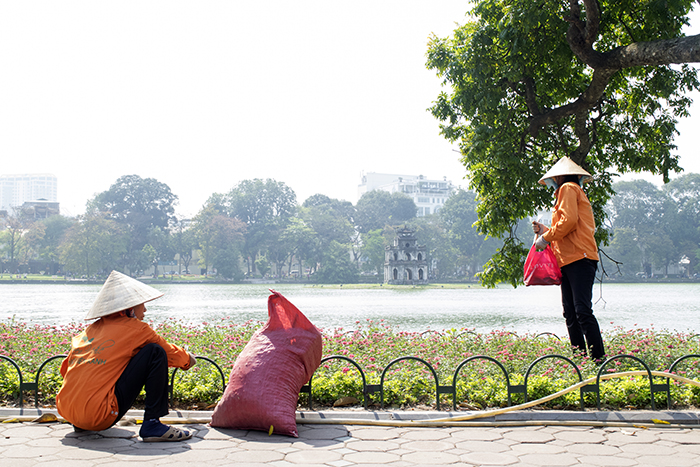
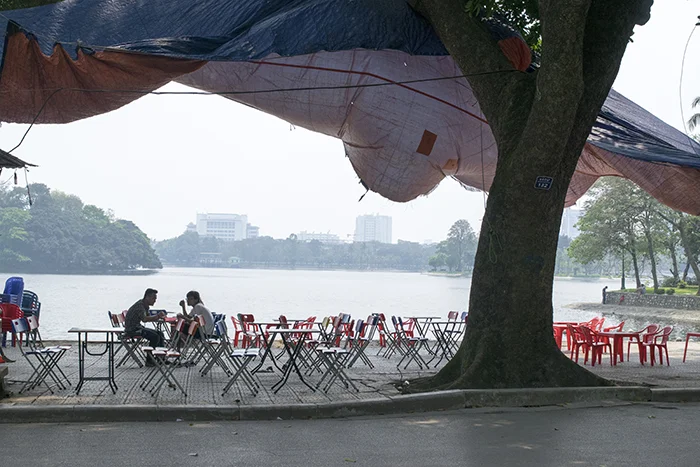
The first item on our to-do list, before sustenance or accommodation, was to pump some caffeine into our bloodstreams and awaken our half-asleep brains. We wandered down a side street across from a bricked-in, perfectly square, man-made pond. Middle-aged Vietnamese people wearing various athletic accessories flanked us. There were wrinkly little women swinging their arms in loops, men stretching in neon, 80’s-style spandex shorts and matching headbands. An energetic beat banged out of scratchy boom box speakers from across the pond. I spotted a group mid-Zumba routine, their arms and legs in clumsy parody of the instructor’s. 

The first open store we came across only sold wooden crates of fresh fruit and vegetables. However, after the smiling saleslady declined our business, she pointed for us to stay and banged on the closed metal awning of the shopfront beside her. As it raised, a pair of pink slippers, pink flannel pajama pants, a matching pink sweater, and finally a pair of bleary eyes and a messy black ponytail became visible. The eyes blinked, taking in the scene. It was obvious that foreigners didn’t come around these parts very often. The two shopkeepers spoke in the sharp, almost sing-song inflections of Vietnamese. Then the pajama-clad woman nodded at us.

She scooted back into the dark and reappeared with a plastic, lavender kiddie table and two matching stools. I hoped she spoke English; we had no Google Translator to reference, no idea how to even say “hello” in Vietnamese. Just two ignorant Americans abroad, I thought.

“Coffee?” Cody asked, his voice tentative. 

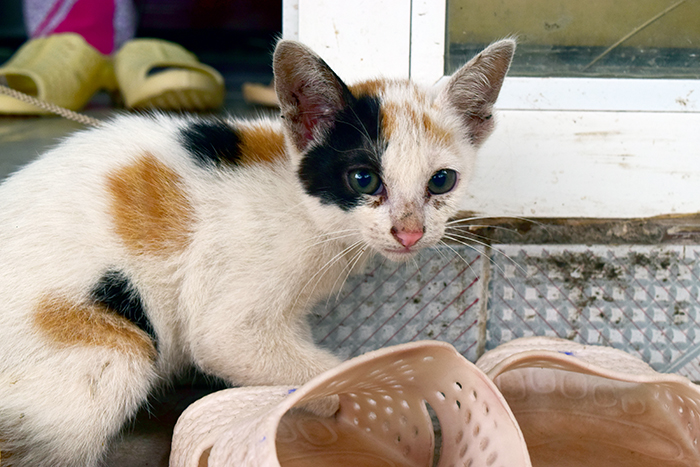
The woman responded with a word that sounded a lot like “cafe.” Cody and I exchanged a glance and a shrug; close enough. She pointed at the miniature table and chairs. We thew our stuff down and squatted on the set. Satisfied we wouldn’t run off, she shuffled back into the shop, which was really just a living room with an open front facing the street. There was a small kitchen area off to the side. The main room had a mantle with a television set, a round metal table surrounded by chairs, and a staircase from which a mewing sound kept coming. A runty calico kitten crawled into view; it was tied to the steps by a piece of rope around its neck. Its oversized, wet, green eyes seemed to weigh its whole head down.

A few moments later the lady came up to us holding a can of condensed milk. It had a puncture hole in the top and the side was glazed with syrupy, white liquid. She shook it at us. I nodded. 

I’d heard rumors about Vietnamese-style coffee, but was still surprised when it came out in all its intricacy. A dented tin contraption sat on top of a teacup immersed in a bowl of hot water. It looked like a can of tuna without the label. I lifted the metal bit to find dark liquid dripping through a thin grate into the cup below, spattering drop-by-drop onto the thick pool of condensed milk that coated the porcelain bottom. I opened the tin’s lid and saw it was filled to the brim with hot water. Loose, brown coffee grits swirled around. 

The liquid took several minutes to migrate through the grate and into the teacup. As we waited, a little girl in a school uniform hopped down the stairs two at a time and the shopkeeper placed a bowl of steaming porridge on the round table. The girl spooned globs of it into her mouth, her eyes glued to the weather forecast on the television. When the kitten stumbled over a pair of rubber slippers and tangled itself in its rope leash, she leapt from her chair to save it.The kitten scrambled over the tiles, pounces on a pair of pink, plastic slippers and stared out at me with wondering green eyes. I smiled at it and the little girl giggled and waved at me. 

"Hello!"

"Hello." When I responded, she giggled more.

"Hello, hello!"

"Hello." I said again.

"Hello!" 

I just smiled this time and she wandered back over to her breakfast.

When the coffee was finally ready, I swirled the black liquid with the condensed milk, transforming it into creamy goodness. You know how coffee-lovers always say things like, “I don’t want Starbucks, I want to go somewhere with good coffee.” That’s the first thing I thought of when I sipped this cup; it’s so good. I could taste the richness of these beans, the hint of refreshing bitterness beneath the sweetness of the milk. The taste lingered after I swallowed.

I tugged my sweater a bit tighter around my torso, holding the hot little cup of coffee between my palms. Motorbikes rumbled past on the streets, zipping out of tight, cobblestoned alleyways that looked like a tight squeeze to walk in, let alone drive through. Everything was colorful, from the pastel-painted buildings to the neon jackets and hats everyone has donned to the huge stacks of fruit that vendors had piled onto carts and were pushing slowly through the streets. I could already tell I was going to like it here, even if I'd just arrived. 

After coffee, I was energized again. We paid and made our way back to the main street. Most shops were now open and many were serving large, steaming bowls of noodle soup to patrons at more plastic kiddie tables set out on sidewalks. Each dish was accompanied by a plate stacked high with greens, limes, and chilies. I hadn’t passed more than a few of these street restaurants before I felt my stomach gurgling for attention. It was time to check another need off the day’s list. We stopped at one of the busier open-faced shops with a “PHO” sign out front. That was one of the few Vietnamese words I recognized; I’d had pho in New York. I thought it was another version of ramen. 

We ended up inside a restaurant, sitting at a fancy table made of thick, glass-like plastic with metal legs that didn’t wobble like the kiddie ones. It was decorated with a blown-up image of a 90’s Britney Spears album cover, from back when she used to wear pig tails and all-denim outfits.

“Duck or pork?” The waiter asked.

For the first time in weeks I’d been offered a protein option that wasn’t pork or chicken! Cody and I both ordered duck without hesitation. And the heaping pile of hot, salty broth, slender, slippery rice noodles, soft, fat black liver chunks, chopped scallions, and slices of golden-skinned, tender roasted duck meat that arrived at the table only a few moments later was breathtaking as it was delectable.

So far, I’d decided, the Southeast Asian country with the best breakfast options was Vietnam. We left the restaurant stuffed, the fresh smells of chili, lime, and mint on our fingertips. It was time to take care of the last item on our to-do list: accommodation.

Cody and I found ourselves pricing out hotels on a large avenue. We’d heard that rooms were a bit more expensive in Hanoi and wanted to do some scouting. We were still about a thirty minute walk from the French Old Quarters (the traditional tourist district) and there were no other Westerners in sight. But then we spotted Flamingo Hotel, whose shiny marble front and automatic glass doors just looked too enticing to pass up. All that fancy glass meant there was air conditioning, right? As we made our way to the front desk, we had to step around workers rearranging the letters on the big blue and silver sign out front. Inside was cool, clean; there was a glass display on one wall that was filled with old cell phones. I wondered if they were selling the brick-like Nokias or if they were just for show.

The front desk had a pretty clear room rate list sitting on it: 600,000 dong (or about $27) per night. It was way above our budget. We were about to walk out when a manager came around the corner, called out to us. 

“Wait, what will you pay?” He sounded desperate. I was surprised that it was possible to haggle in this kind of place. Cody and I both hesitated.

“Um, 400,000?” Cody said. The manager frowned. We began to turn toward the door again.

“Okay, sure! Sure. But I can’t include free breakfast. That’s too much.” 

Who gives a fuck about free breakfast? We can stay in a real hotel for less than $10 each!

We followed the eager manager up a dimly lit set of stairs and through a dirty hallway. The gray carpeting was stained, the walls were bare. But when he led us through a door on the second floor, we stepped into one of the nicest hotel rooms I’d seen in a while. He explained that it was cheaper because there were no windows. But there was a flat screen television on the wall and a king size bed with a spotless, white duvet. The bathroom came with little bottles of shampoo and conditioner, toothbrushes, bars of soap, and even a razor and shaving cream set. The shower head was as wide as a dinner plate, waterfall style. Freaking luxury to two people that hadn’t bathed in almost three days.  

“Yeah, this works.” I nodded. Definitely works. 

The manager grinned, looking relieved we actually wanted to stay here. I noticed that the hallways were silent; were we the only customers? Did it even matter? 

“Actually, because it’s my wife’s birthday, you can have free breakfast!” The manager told us. He clapped his hands together. 

We had ourselves a deal. 


Expenses:

  • Hotel Room: Whatever you’re willing to pay
  • Coffee: $1.00
  • Giant bowl of duck pho with all the greens and chili your heart desires: $1.00

Travel Tips:

  • If something gets stolen from a bus, most likely you’re not getting it back. Don’t fret, just remember that most material objects are replaceable. Or keep your stuff safer.
  • Write down a few key phrases before you go to a new country, just in case you don’t have a SIM card to help you.
  • Always be ready when the opportunity to haggle arises.